

Politics
Extortion, bureaucratic inertia stall birth registration in southeast Ni


By Alfred Ajayi
At the Primary Health Centre in Egbu, Owerri North Local Government Area of Imo State, Cynthia Ikwundu sat quietly on a wooden bench waiting for her infant son to be circumcised.
It had been a week since the infant received his first round of routine immunisations, and for Ikwundu, navigating his immediate medical needs was a daily, exhausting reality. Birth registration, however, was the furthest thing from her mind.
Growing up, neither she nor any of her biological siblings had their births registered with the government. She had made do with a certificate issued by the Church for child dedication.
So, for 20 years, her existence was only in the memories of family, friends, and neighbours. The new mum was largely invisible to the government and non-existent to demographic projections.
Years later, Ikwundu faced the consequences of living without a recognised identity. The church certificate she once relied on was no longer sufficient in a corporate world where only birth certificates or attestations of birth were acceptable.
“I needed a job in Abuja, and I was asked to provide my birth certificate as a mandatory requirement for employment,” she recalled. “I had to call my mother in the village and eventually travelled home for a birth attestation.”
She learnt a critical lesson from that experience. “Without that piece of paper, a citizen has no formal existential relevance,” she said.
Birth registration, according to Dr Joachin Ulasi, a former Director of Cartography at the National Population Commission (NPC), is critical for modern survival. Ulasi, who is also a former State Director in Anambra State, describes it as supporting evidence of nationality and required for school enrollment to determine the mandatory age limits for admission into primary, secondary, and tertiary institutions.
“If you look for a job, it is used to ascertain if you meet the civil service appointment age requirement. Financial institutions demand it for basic banking transactions. A birth certificate is the fundamental prerequisite to obtain a passport or visa,” he said.
Low early birth registration
Globally, 166 million children under five remain unregistered. Africa contributes a significant share, with only 44% of children recorded at birth. In West Africa, Nigeria stands out, as more than half of children under five lack birth certificates, accounting for 11% of the region’s unregistered population.
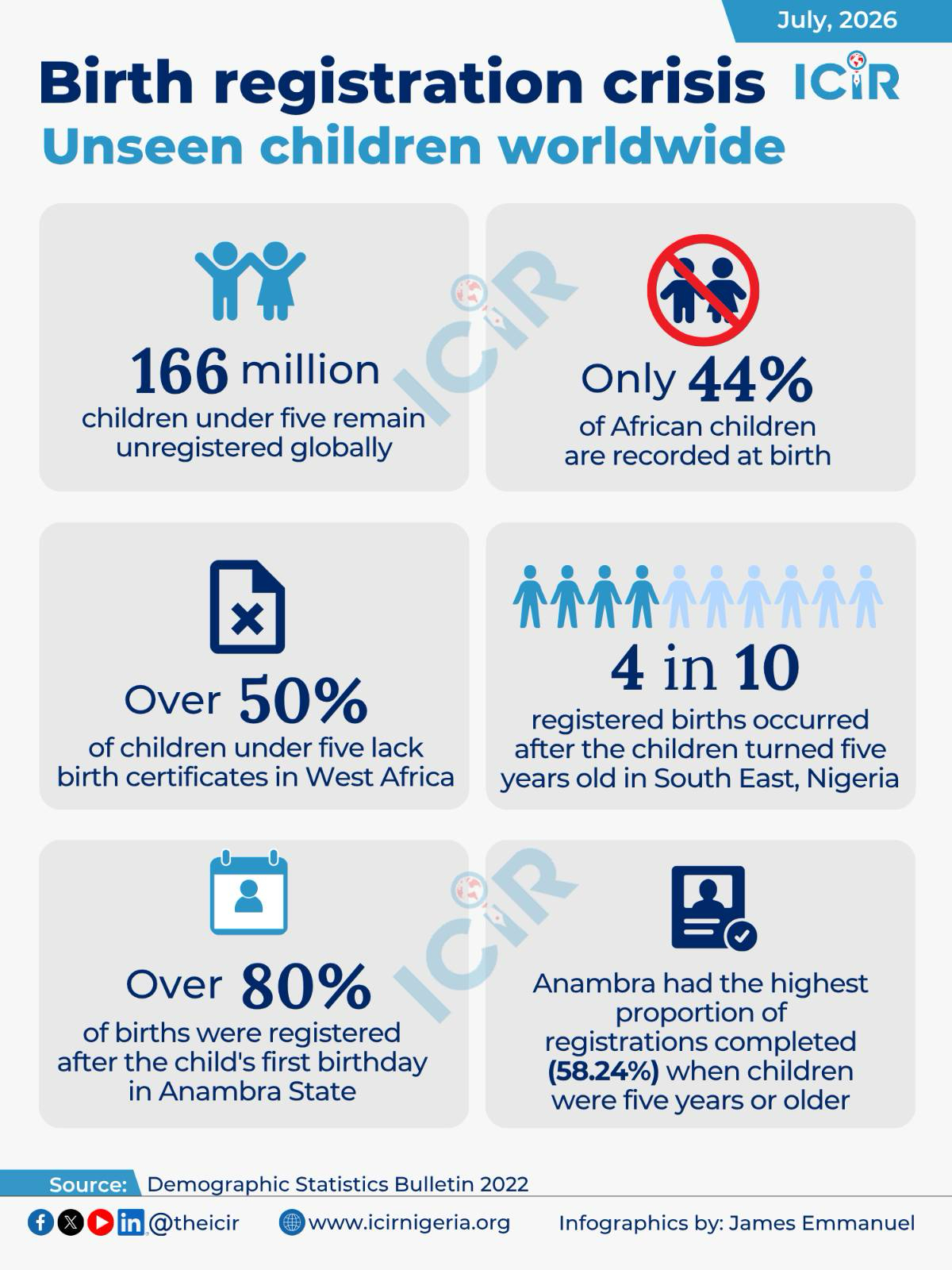
According to the Demographic Statistics Bulletin 2022, the southeastern part of the country recorded the lowest percentage of timely birth registration, as more than four in every 10 registered births occurred only after the child had turned five years old. This suggests widespread delays rather than an absence of registration altogether.
Nationally, state-by-state disparities reveal that Anambra had the lowest proportion at 19.83%, meaning more than 80% of births were registered after the child’s first birthday. Anambra also had the highest proportion of registrations completed when children were five years or older (58.24%), indicating a strong culture of delayed registration.
Allegation of extortion
The gaps in the southeastern part of the country are driven by allegations of extortion by state officials, compounded by institutional bottlenecks and widespread public ignorance.

When Cynthia Ikwundu decided to do the right thing for her next generation, she ran into a transactional barrier.
She regretted that the certificate, officially meant to be issued free of charge, had been incrementally commercialised. “For my first child, born in 2023, I paid about ₦500 for the certificate. For my second child, I spent between ₦1,000 and ₦1,500. It’s not supposed to be,” she said.
The same story of extortion is replicated in other communities visited, such as Mgbidi, Aji, and Naze in Imo State, as well as Umueze-Anam, Aguleri, Otuocha, Nteje, Atani, and Akili-Ozizor in Anambra State.
In Ebonyi State, findings from Igbeagu, Ezza Inyimagu, Mgbalukwu Inyimagu, Ugbodo, Amachi, and Ishieke point to consistent violations of extant laws.

Responsible for nationwide censuses, demographic management, and civil registration, the National Population Commission (NPC) plays a pivotal role in shaping national development. Its core mission is to deliver accurate, reliable, and scientifically validated population data.
These arbitrary charges for birth certificates for infants violate the Births, Deaths, etc. (Compulsory Registration) Act, No. 69 of 1992, where Section 10(1) mandates registration of birth within the first 60 days of life, while subsection 2 permits extension up to 12 months.
Section 15 explicitly mandates that a certificate of birth registration must be issued free of charge for children.
However, for certificate and registration of birth after the time limit, the Act prescribes N50,00 as a charge from two to 12 months, while registration later than 12 months attracts N100.00.
The commission now operates under Section 153(j) of the 1999 Constitution of the Federal Republic of Nigeria (as amended). But its mission is being undermined with a growing likelihood of inaccurate data, largely because a vast number of births continue to go unregistered.
In Umueze-Anam, Anambra West Local Government Area, for instance, Nkechi Okoye recounted that none of her three children has ever been registered with the NPC.
“My first child is already 13 years old, the second is five, and the youngest will be one this coming September. I don’t have the money for such,” she said.
“They came here two years ago to register people for free, but they never got their certificates,” she regretted.
Section 6 of the Child Rights Act 2003 guarantees every child a right to identity. However, the economic hardship and commercialisation of the process remain a towering barrier for poor households, including that of Onyekachi Nwovu, a mother of three in Igboagu, Izzi LGA of Ebonyi State.
“I have three children, the oldest five years old and the youngest eight months old. I don’t have ₦5,000 to register each of them,” she told this reporter.
Findings across communities and Primary Healthcare centres (PHCs) revealed that some health workers are complicit in the extortion.
Johnmark Chinonso works with Umueze-Anam PHC 1 but helps potential registrants in Anambra West LGA. He says there is no fixed price for obtaining a birth certificate.
“For children under five, I collect ₦1,000 or ₦2,000. Five to 10 years – ₦2,500. 10 to 15 years, I collect from ₦3,000 to ₦5,000, depending on how I perceive the person. The man in the NPC office in Awka collects ₦15,000 or more for people who are more than 17 years old,” he explained.
At the Ndigwe Igbeagu PHC, Izzi LGA, Ebonyi State, Linda Ogah, a volunteer nurse, expressed worry that these combined structural hurdles and extortions discourage compliance.

“They charge ₦3,000 per certificate here. Some of these mothers struggle to find ₦300 for the immunisation fee. Mothers often query what immediate benefit they or their babies will get from the registration,” she said.
At the Maternal and Child Health (MCH) Centre in Nsugbe, Ebonyi LGA of Ebonyi State, an anonymous internal source said the NPC official in the facility charges ₦3,000 for a certificate.
Also, at the health centre, which operates from a ramshackle, dilapidated structure and is restricted to a weekly immunisation clinic, this reporter observed dozens of nursing mothers. “Initially, the officials collected ₦1,000 for a birth certificate. It later increased to ₦1,500. I paid ₦2,000 for my own child,’ said the source who added that, “presently, they are collecting either ₦2,500 or ₦3,000. The officer in charge told me directly that their office instructed the cost”
Chisom Dickson, a nursing mother, alleged that an NPC official at Naze PHC in Owerri North charged ₦3,200 for the certificate. “I did not have such money for the certificate. I will get it later when I can afford it,” she said.

Essence of birth registration
Dr Jude Ohanele, the Founder and Program Director of Development Dynamics, a non-governmental organisation based in Owerri, Imo State, decried what he termed the mismanagement of a critical aspect of Nigeria’s national life.
In his view, accurate birth and death registrations would have assisted Nigeria in determining its true population size, having failed to conduct a population census since 2006.
“For instance, such data will inform you that children born in 2026 will be 12 years old by 2038 and will be leaving primary school. Also, the plan for future secondary education or healthcare infrastructure is driven by data, not assumptions,” he said.
Dr Ohanele alleged that, given its widespread nature, NPC cannot claim to be ignorant of the extortions happening. “It is completely unreasonable to imagine that a citizen should pay to be captured,” he said.
“The NPC is well aware of this grassroots extortion. It seems they view it as an opportunity to extort money from Nigerians, especially those processing international passports, which is condemnable.”

Even with widespread allegations of extortion, this reporter found that the establishment act does not prescribe specific penalties for it.
A former NPC director in Anambra, Dr Ulasi, attributed the extortion partly to inadequate staffing in rural communities and the digitisation of birth registration. He, however, stressed that erring NPC officials who are civil servants face disciplinary measures under the civil service rules, with penalties ranging from suspension to dismissal depending on the gravity of the offence.
He said the commission created “catchment areas,” requiring a registrar to cover multiple communities on a rotating basis. “Given the vitality of birth registration to development planning, every single community should have at least one permanent registration centre,” he said.
Ulasi recalled that, while he was in service, UNICEF and the federal government funded the direct printing of certificates that were issued freely. “However, before my retirement, the commission switched to digital birth registration in partnership with an external ICT firm. At that, charges came in.”
Equally responding to the allegation of extortions, Dr Jeremiah Nwankwe, the NPC national commissioner representing Ebonyi State, confirmed that any charge levied on a child under five remains illegal.
“Children below five years should absolutely not be charged any fee whatsoever. Those above five years pay a defined legal penalty for late registration, while from 17 years and above, the commission approved that they must pay ₦15,000 for birth attestation, not a certificate.”
On disciplinary measures against erring staff, Dr Nwankwe said such has not come to his notice before. “However, we have internal mechanisms for handling such misconduct.”
When contacted by phone on Tuesday, 23 June 2026, the Anambra State NPC Director, Mr Okagwu Obi Kenechukwu, requested that the questions be sent to him for a phone response, but he did not respond. Following reminders on Thursday, 25 June, and Monday, 29 June 2026, he referred the reporter to the federal commissioner representing Anambra.
At a press briefing on July 24, 2026, the federal commissioner representing Anambra, Mr Chidi Ezeoke, acknowledged that reluctance among some residents remained a major obstacle to achieving universal birth registration.
“Unfortunately, people are reluctant to register their children because of religion, culture and other mundane reasons, even with the registration centres at various hospitals and health centres across the state,” he said, adding that many births that occur in traditional birth homes escape the registration system, making it difficult for the commission to capture them.
The federal commissioner, however, expressed optimism that the newly introduced Electronic Civil Registration and Vital Statistics (E-CRVS) system would significantly improve birth registration. He added that the commission has trained its personnel on electronic registration and provided standby generating sets to ensure uninterrupted operations during power outages.
Ezeoke also said the commission has established 131 registration centres across the 21 local government areas of Anambra State, with plans to open additional centres.
But stakeholders point to poor inter-agency coordination as another factor undermining the progress. Dr Jeremiah Nwankwe, the federal commissioner in Ebonyi, said state governments were not being supportive. “They say NPC is a federal agency and should be strictly taken care of by the federal government. But it is domiciled in their states and serves their people,” he argued.
“In 2024, UNICEF partnered with us with a target of 169,000, but we registered almost 200,000 children.” However, he said those certificates were not generated due to a paucity of funds and logistical problems. In 2025, he said they faced a decline. As at June 2026, he said the same logistical problems are frustrating the process.
Beyond logistics and funding challenges, citizens’ distrust in government is another worrisome issue, says Emmanuella Anyanwu, the Officer-in-Charge of Umueze-Anam 1 PHC.

“When you try to encourage them to register their births or take immunisations, they tell you that their grandmother or mothers-in-law said it is not necessary,” she said, adding that widespread use of traditional birth attendants (TBAs), coupled with weak government regulation, hinders birth registration, as most children born by TBAs go unrecorded unless they later have contact with public health facilities.
Be that as it may, Nneka Nnadi, the Assistant Officer-in-Charge at the facility in Naze, Owerri North LGA, was happy about spreading awareness and a better response to birth registration. “We incorporate teaching on the importance of birth registration into the health talks during the antenatal programme. So, more people are positively responding,” she said.
Also, Gift Ekechi, the Assistant Officer-in-Charge of Egbu PHC, said her team views birth registration as an extension of maternal healthcare. “Once they bring their babies for BCG vaccinations, we link them to the birth registration desk and encourage them to obtain their certificates immediately.”

Imperative of reform
On July 1st, the NPC launched a digital self-service birth registration portal to improve access to services and reduce extortion. The portal explicitly states that birth registration for children under five remains free at NPC registration centres. It, however, states that beneficiaries of the self-service option are required to pay a processing fee of ₦2,000.
To improve the integrity of data for national planning, policy experts also advocate legislative restructuring and other reforms.
For instance, the Births, Deaths, etc. (Compulsory Registration) Act prescribes penalties such as N200 or six months of imprisonment or both for certificate forgery, while a registrar who refuses or, without reasonable cause, omits to register any birth or death is fined N1000 or six months imprisonment.
It states that a parent who fails to give information concerning the birth of his child is liable upon conviction to a fine of not more than N50 or one month’s imprisonment. This is the same for any person who willfully obstructs the work of the registrar or any other officer duly authorised.



