

Politics
Spain Deploys Troops As 49,000 Migrants Cross Into Ceuta, 19 Dead


Spain has deployed its military to restore order in the North African enclave of Ceuta after an estimated 49,000 migrants crossed from Morocco by land and sea within 24 hours, in what authorities described as the country’s biggest border crisis since at least 2021.
The unprecedented surge prompted Spain and Morocco to reinforce security along the border on Friday, with Moroccan authorities deploying water cannon trucks and pushing back crowds attempting to enter the Spanish territory. At least 19 bodies were recovered from the water following the mass crossing, while several others reportedly died during the attempts to reach Ceuta.
The influx has also triggered political tensions across Europe, with Italian Prime Minister Giorgia Meloni threatening to suspend the Schengen Agreement with Spain over migration concerns.
Spanish Prime Minister Pedro Sánchez was scheduled to visit Ceuta on Friday alongside Interior Minister Fernando Grande-Marlaska to assess the situation.
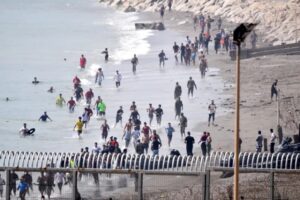

On the Moroccan side of the border, thousands of migrants gathered overnight in the town of Fnideq despite heightened security, with many moving along the coastline in search of alternative routes while others prepared to swim into Spanish territory.
Near the border crossing, the charred remains of a bus and seven vehicles were visible following clashes between security personnel and migrants.
Spanish authorities said they would seek the swift return of migrants who entered illegally while complying with recent court rulings and international human rights obligations.
Ceuta and Melilla, Spain’s two autonomous cities on Morocco’s northern coast, are the European Union’s only land borders with Africa. Both have long experienced waves of attempted illegal crossings, but officials said the latest influx was unprecedented.
Spain’s Territorial Policy Minister, Angel Victor Torres, suggested the surge may have been influenced by a recent Supreme Court ruling preventing authorities from immediately returning migrants intercepted at sea while attempting to reach Ceuta or Melilla.
Torres told a local radio station that the government had responded swiftly to the situation.
“The government reacted immediately to the surge and will proceed to eventually return the migrants while respecting court rulings and migrants’ rights.”
However, Moroccan activists questioned whether the court decision was responsible, arguing that most migrants were unlikely to have been aware of the legal development.



Spain’s government announced that the Armed Forces would assist the Civil Guard in maintaining security across Ceuta after local authorities requested urgent reinforcements.
Rachid Sbihi, who heads the association representing Spain’s Civil Guard officers in Ceuta, described the situation as overwhelming.
“The situation is absolute chaos. It’s not possible to give precise numbers, but there are thousands of migrants crossing. The border has totally collapsed.”
Achraf Maimouni of the Moroccan Association for Human Rights also described the developments as exceptional.
“The Tarajal border was opened under unusual circumstances this morning and people crossed.”
Video footage from the area showed thousands of people, including families with women and children, entering Ceuta through Tarajal beach. Some migrants reportedly shouted, “Viva España!” as they crossed.
Spain’s Guardia Civil police association (AUGC) said there were too few officers deployed during Thursday’s surge to effectively monitor the border fence.
Meanwhile, several migrant rights organisations in Ceuta urged authorities to rethink migration policies.
In a joint statement, the groups said:
“Migratory policies require a deep revision that addresses the reality of the south border and guarantees the respect of the dignity and human rights of the migrants and refugees who arrive to Ceuta.”
They also warned that existing facilities in Ceuta were insufficient to accommodate the large number of arrivals.
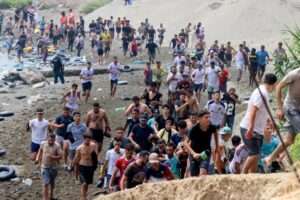
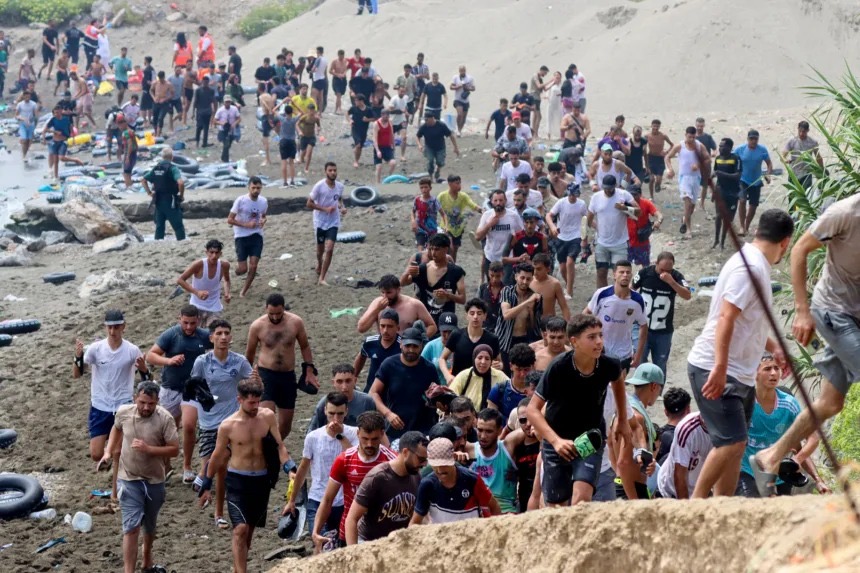


The crisis quickly reverberated across Europe, where migration remains a politically sensitive issue.
Italian Prime Minister Giorgia Meloni warned that Italy could suspend participation in the Schengen border-free area with Spain.
“We are prepared to intervene with extraordinary measures to defend the borders and the safety of citizens, including the suspension of the Schengen Area with Spain,” Meloni said.
Italian Foreign Minister Antonio Tajani also criticised Spain’s migration policies, writing on X:
“The images coming from Ceuta show how the Madrid Government’s decision to grant Spanish, and therefore European, citizenship to over 500,000 irregular immigrants is profoundly wrong and encourages human trafficking.”
Spain’s Foreign Minister José Manuel Albares dismissed the remarks, describing them as inappropriate.
“Spain expects solidarity and not partisan demagoguery from its partner.”
Albares also announced plans to summon the Italian ambassador to formally protest Tajani’s comments.
The latest developments recall the May 2021 migration crisis, when more than 8,000 migrants crossed into Ceuta within two days after Morocco was accused of easing border controls during a diplomatic dispute with Spain.
Ceuta’s regional government has again appealed for additional security measures, warning that migrant reception centres have exceeded capacity and hundreds of people are sleeping on the streets.
Spain’s Interior Ministry said Madrid and Rabat were working closely to facilitate the return of those who entered Ceuta illegally while ensuring border security and public safety.
Migration remains one of Europe’s most contentious political issues, particularly since the 2015 migrant crisis that saw more than one million people seek refuge across the continent. The latest surge into Ceuta is expected to reignite debate over the European Union’s migration and border management policies.
We’ve got the edge. Get real-time reports, breaking scoops, and exclusive angles delivered straight to your phone. Don’t settle for stale news. Join LEADERSHIP NEWS on WhatsApp for 24/7 updates →



