

Health
How HIFU transforms fibroid treatment without surgery

Imagine women with uterine fibroids across Nigeria having access to a treatment option that removes their tumours without a single incision, blood transfusion, or hospital stay.
For many decades, the major treatment options available for uterine fibroids were invasive surgical procedures, either myomectomy or hysterectomy.
Both myomectomy and hysterectomy carry surgical risks, including heavy bleeding, pelvic infections, and accidental injury to nearby organs such as the bladder or bowel. Other potential complications include scar tissue formation (adhesions) and uterine rupture in future pregnancies.
Today, however, a medical technology known as High-Intensity Focused Ultrasound (HIFU) has revolutionised fibroid treatment, giving women a safer, non-invasive option without going under the knife or facing many of the complications associated with surgery.
HIFU is a modern, non-invasive medical treatment used to manage uterine fibroids without the need for surgery.
It uses focused ultrasound waves to target and destroy fibroid tissue deep within the body without affecting surrounding organs.
Unlike traditional surgical procedures such as myomectomy or hysterectomy, HIFU does not involve cuts, stitches, or blood loss.
Experts explain that the treatment is performed externally, with ultrasound energy directed precisely at the fibroid, causing it to heat up and gradually break down.
Using real-time imaging and focused ultrasound waves, HIFU generates heat that accurately destroys fibroid tissue while preserving surrounding healthy organs.
Fibroids are non-cancerous growths that develop in or around the uterus. Many women have them without knowing, but for some, they can affect comfort, menstrual periods, fertility, and quality of life.
In Nigeria, where fibroid prevalence is high and surgical risks are often compounded by limited access to advanced healthcare, experts describe HIFU as a game changer. They say it empowers women to seek treatment earlier, avoid complications, and preserve their reproductive health with confidence.
Introduced in 2002 at the University of Oxford, HIFU is now available in five African countries, including Nigeria.
It was first introduced in South Africa, followed by Egypt, Nigeria, and later Kenya, with thousands of women embracing the procedure.

In Nigeria, HIFU is pioneered by the Fibroid Care Centre at Nordica through an international partnership with Chongqing Haifu Medical Technology Co. Ltd., Chongqing, China.
Through this partnership, Nordica established the first ultrasound-guided HIFU Centre in Nigeria and West Africa in 2021, offering advanced non-invasive treatment for fibroids and other benign uterine conditions.
The Managing Director of Nordica Fertility Centre and the Fibroid Care Centre at Nordica, Dr. Abayomi Ajayi, said HIFU is now used in more than 37 countries and has successfully treated over 500,000 women with fibroids without surgery.
Speaking during the recent visit of the HIFU technical team from China to the Fibroid Care Centre at Nordica in Lekki, Lagos, Ajayi disclosed that nearly 1,000 fibroid patients in Nigeria have undergone the procedure.
Highlighting its numerous advantages, the fertility specialist told journalists during a media interaction that there is sufficient evidence demonstrating the safety and effectiveness of HIFU in fibroid treatment.
“We started this journey about five years ago. We are nearing 1,000 patients with fibroids that we have treated with HIFU. That is not just the news; the news is that HIFU technology is going global and becoming increasingly popular worldwide.
“About 37 countries are using HIFU, and about 500,000 women have benefited from this technology. In Nigeria, we are approaching 1,000 patients, and we thought it was important to talk about this.
“We also have our partners on the ground so that you can exchange ideas with them. We are not just talking about HIFU from a local perspective; they have a global picture of what HIFU is achieving,” Ajayi said.
The fertility specialist described HIFU as the future of fibroid treatment, particularly in Africa, citing its remarkable advantages.
“In a resource-constrained environment like Africa, this is what we should be doing. The government should encourage this kind of innovation. The learning curve is short. You can eat immediately after the procedure. There is no blood transfusion, no anaesthesia, no hospital stay, and patients can resume normal activities within a couple of hours. HIFU is also one of the best treatments for adenomyosis.
“Most importantly, HIFU preserves fertility, and women can conceive and have normal pregnancies after treatment.
“HIFU has many advantages, and there is enough evidence that it works,” he said.
The fertility expert explained that HIFU works by delivering focused ultrasound waves deep into the body to generate heat that destroys fibroid tissue without a single incision, blood transfusion, or hospital stay.
According to him, with the procedure guided by precise imaging—either MRI or ultrasound—fibroids can be targeted with pinpoint accuracy.
A 2023 article published in PMC PubMed Central titled “Uterine Fibroids—Causes, Impact, Treatment, and Lens to the African Perspective” states that Black women are at a higher risk of developing fibroids than women of other racial groups.
With Nigeria being the most populous Black nation in Africa, fibroids are expected to be common among Nigerian women, although there is limited local data to quantify the burden.
According to Ajayi, many women develop uterine fibroids by the age of 50, although they are most common among women in their 40s and early 50s.
He attributed fibroids to a combination of genetic, hormonal, and environmental factors, noting that their exact cause remains unclear.
The maternal health expert maintained that there is sufficient evidence supporting the effectiveness of HIFU in treating fibroids.
“Very soon, we are going to train more Nigerian doctors on HIFU.
“We have enough evidence to show that HIFU works,” he said.
The gynaecologist urged the media to raise more awareness about the procedure to enable more women to access it, stressing that public awareness is critical to increasing confidence in the treatment.
“Nobody wants to have surgery. But people need to be convinced that HIFU works. We are treating patients who have even undergone three previous myomectomy procedures. We just need to increase awareness,” he said.
He noted that the Fibroid Care Centres in Lagos and Abuja, which currently offer HIFU treatment in Nigeria, represent a beacon of hope for women facing limited treatment options.
To further expand access, Ajayi disclosed that Nordica donated an HIFU machine to the Federal Capital Territory Administration in June as part of activities marking the second edition of Abuja Reproductive Health Week 2026.
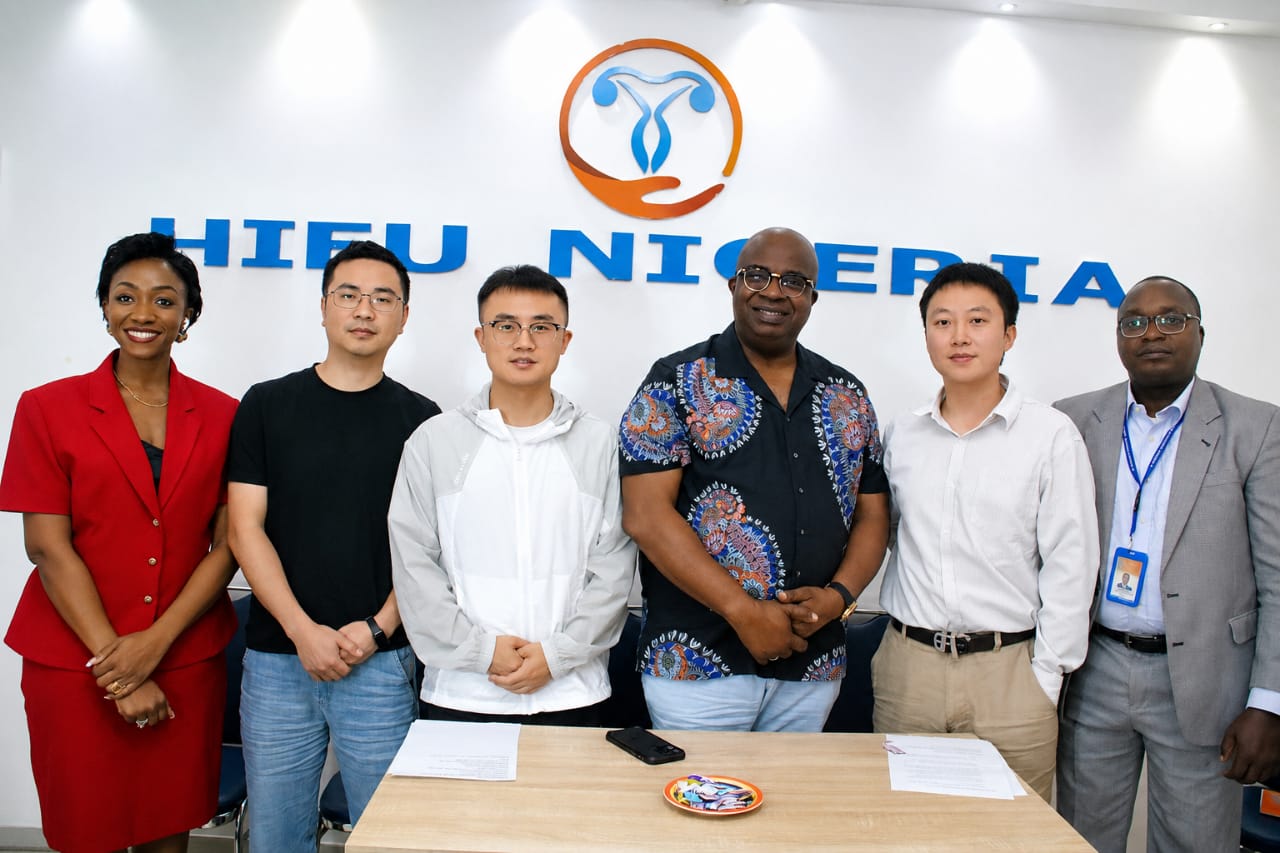
Sharing their experience with HIFU adoption in Nigeria, members of the Chinese technical team commended Ajayi and his team for their vision and determination in making the technology available in the country.
Speaking during the visit, International Sales Manager, HIFU Medical, Chongqing, China, Mr Yinghao Jason, said the company’s partnership with Nordica goes beyond supplying equipment.
“Haifu provides ongoing medical support and engineering maintenance to ensure our partners master the technology. We train Nigerian doctors both locally and in Chongqing. This is a long-term partnership aimed at building local capacity and sustaining high-quality care,” he said.
Jason, who gave further insight into the availability of HIFU technology in Nigeria, said the partnership with Nordica began in February 2020, when Haifu introduced its non-invasive HIFU technology.
“Dr Abayomi Ajayi, founder of Nordica Fertility Centre, immediately recognised its potential. He had spent seven years searching for a better way to treat fibroids—one without surgery, scars, or the risk of compromising fertility.
“In December 2020, Dr Ajayi visited Chongqing to see the technology firsthand. Convinced of its benefits, he brought the first HIFU system to West Africa. On July 9, 2021, the Haifu JC200 system was officially inaugurated at the Lagos centre, and the first patient was treated the same day,” he said.
Highlighting the programme’s impact, Jason added, “Today, we have two centres—one in Lagos and one in Abuja. Together, they have successfully treated 965 patients, with no deaths, no blood transfusions, and no major complications. These are not just numbers; they represent women who have regained their health and returned to their families and careers.
“As Professor Rosie Xing said, the Nordica centre ‘stands out among Haifu’s 60 global centres’—a tribute to Dr Ajayi and his dedicated team.”
Jason pledged that Haifu and Nordica would continue working together to ensure that no woman in Nigeria has to fear fibroids again.
Also speaking, HIFU Medical Director, Dr Wanxiang Guo, highlighted the cordial relationship between his organisation and Dr Ajayi in advancing HIFU treatment for fibroids in Nigeria.
He reaffirmed the organisation’s commitment to Nigeria, pledging to strengthen the country’s healthcare sector through HIFU training for doctors, medical research, and sustained technical support for the Nordica team.
On her part, the Chief Operating Officer of Nordica Fertility Centre, Dr Tosin Ajayi-Adeniyi, said, “We have recorded 30 pregnancies following HIFU treatment. Here at the Fibroid Care Centre at Nordica, we are helping women who want to have children achieve pregnancy while ensuring that fibroids do not stand in their way.”
Copyright PUNCH
All rights reserved. This material, and other digital content on this website, may not be reproduced, published, broadcast, rewritten, or redistributed in whole or in part without prior express written permission from PUNCH.
Contact: health_wise@punchng.



