

Health
Dangote, Sanwo-Olu back Atunse’s local biologics manufacturing drive

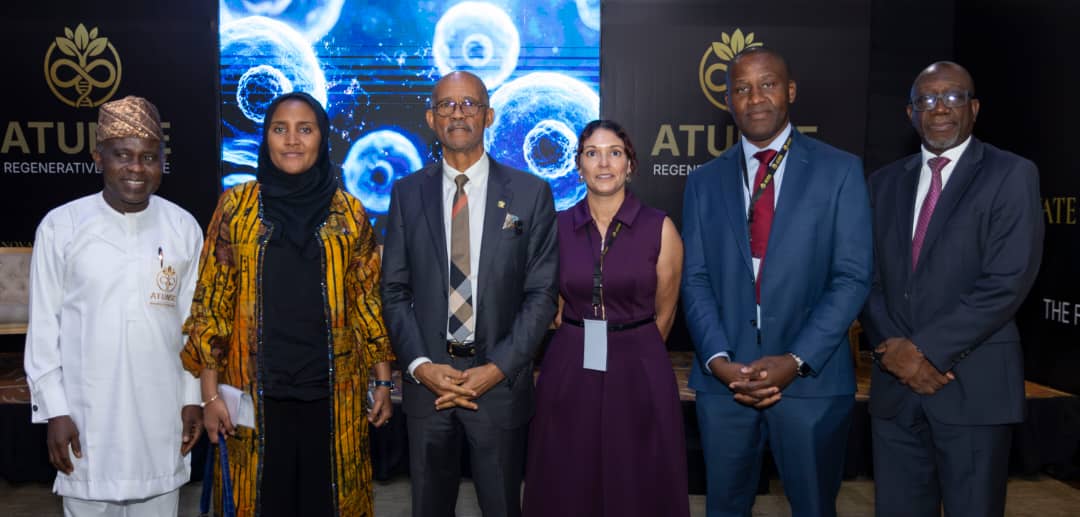
President and Chief Executive Officer of the Dangote Group, Aliko Dangote, and Lagos State Governor, Babajide Sanwo-Olu, have rallied support for Atunse Healthcare Ltd.’s efforts to advance regenerative medicine and local manufacturing of advanced biologics in Nigeria and Africa.
Dangote and Sanwo-Olu declared their support at the African Regenerative and Longevity Summit in Lagos, which also marked the official launch of Atunse Healthcare, described by stakeholders as an effort to build Nigeria and Africa’s capacity to produce advanced medicines locally.
The African-led company has intensified efforts to build manufacturing, distribution and specialist workforce capabilities so that Nigerians no longer have to leave the country to access advanced medical care.
Experts say for a generation, the most advanced medical treatments available to Nigerians have been those they travelled abroad to access — if they could afford the journey.
The company is already treating patients across six service lines: aesthetic medicine, longevity and vitality, men’s wellness, women’s wellness, musculoskeletal support and neurological care.
Delivering a keynote address, Dangote, who was represented by his daughter and Group Executive Director of Commercial Operations for Oil and Gas at Dangote Industries, Fatima Aliko Dangote, said Nigeria and Africa must reduce their dependence on foreign aid and build self-sufficient health systems.
“COVID-19 taught us a very important lesson: dependence is a vulnerability. When a crisis comes, every country first looks after itself, and we saw what happened with vaccines, diagnostics, medicines and other essential health technologies. So, for us in Africa, medical sovereignty cannot just be a slogan. It is about building the capacity to protect our people.
“That is why initiatives like Atunse are important. We must begin to ask ourselves: how do we move from being consumers of advanced medicine to becoming producers of it?” Dangote said.
He noted that Nigeria had the talent, entrepreneurial energy and market to achieve this.
Dangote added, “What we need is to bring those things together — investment, science, enterprise and the right partnerships — and build the capability here.
“The future of healthcare in Nigeria, and indeed across Africa, cannot be built by the government alone, nor can it be built by the private sector in isolation.
“It should be built where public focus meets private capability, where policy creates an enabling environment, and enterprise brings execution, investment, innovation and scale.”
In his remarks, Sanwo-Olu, who was the Special Guest of Honour, said initiatives such as Atunse were important for building the capacity to understand the health needs of Nigerians, develop the expertise to respond to them and create the infrastructure required to deliver advanced care locally.

Represented by the state’s Commissioner for Health, Prof. Akin Abayomi, the governor said, “We need our own experienced specialists back to do this. When we start seeing initiatives like this, it starts to encourage our own experienced specialists to come back home. This is the kind of initiative that is attractive to doctors and scientists doing great things abroad because when you ask them to come back, they can come back and work in centres like this.”
Sanwo-Olu stated that regenerative medicine was one of the exciting frontiers in healthcare, adding, “For us in Lagos, the question is how do we make sure that the science, the people and the systems are there to take advantage of it?”
“We have a huge gap in our health workforce. We must train more people; we have to build the institutions, and, where there are gaps, we have to find ways to bring expertise back into the country.
“This is where initiatives like Atunse become important. When you begin to see this kind of private-sector investment happening, it creates an environment that can attract scientists and specialists back home. Government cannot do this alone. We need the universities, the researchers, the healthcare providers and the private sector working together,” Sanwo-Olu said.
He assured that the state government would continue to create the environment and systems that allow innovation to happen and ultimately “improve the health of our people.”
President and Chairman of Atunse Healthcare, Prof. Kamar Adeleke, said that, for a generation, the most advanced medical treatments available to Nigerians had been those they travelled abroad to access — if they could afford the journey.
“Atunse was established on the position that they should not have to, and that the capability to deliver and eventually produce such medicine belongs on the continent rather than at the end of an import chain.
“The company is already treating patients across six service lines: aesthetic medicine, longevity and vitality, men’s wellness, women’s wellness, musculoskeletal support and neurological care.
“Africa imports approximately 99 per cent of the vaccines and more than 95 per cent of the medicines it uses, producing under one per cent of its own vaccine supply,” Adeleke said.
According to him, the cost of that dependency was visible in Nigeria, disclosing that an estimated $2.39bn left the country in 2024 as citizens sought medical care abroad.
“The greater cost is borne by those who cannot travel, and for whom advanced treatment has simply not been an option.
“Atunse Healthcare Ltd. is a partnership between KweHealth, LLC of the United States, which contributes an established scientific and manufacturing platform, and Tri-State Healthcare System of Nigeria, which contributes clinical delivery and institutional depth. The company is Nigerian-domiciled and Nigerian-based,” he said.
The company’s strategy focuses on clinical delivery, advanced biomanufacturing, research and clinical translation, and regulatory capacity.
“It is building four capabilities together rather than in sequence. Clinical delivery through a treatment centre in Nigeria. Advanced biomanufacturing, working towards cGMP-grade production of advanced biologics in Nigeria, with a roadmap extending to vaccines and, in time, cell and gene therapies.
“Research and clinical translation, so that discovery and evidence generation take place in Africa and African patients are participants in the science rather than only recipients of its outputs. And regulatory capability, developed in active alignment with NAFDAC on the pathway for advanced biologic products,” the professor explained.
Local manufacturing, he noted, had a workforce consequence that the company treated as central rather than incidental.
He added, “Biomanufacturing, quality assurance, regulatory science and clinical research are high-skill, durable roles, and Nigeria has few of them because it has had little to practise them on.
“Atunse’s position is that a country which manufactures without training its own scientists, and without governing its own standards, has substituted one dependency for another. The African Union has committed the continent to producing 60 per cent of its own health products locally by 2040.”
Also speaking, the Chief Executive Officer of Atunse Healthcare Ltd., Dr Sola Oluwole, said Africa was not asking to be admitted to the field.
“It is joining it — as a manufacturer and as a clinical partner, working on the health problems this continent actually has. The science does not become African by being applied here. It becomes African when it is made here, studied here, and taught here,” Oluwole said.
Copyright PUNCH
All rights reserved. This material, and other digital content on this website, may not be reproduced, published, broadcast, rewritten or redistributed in whole or in part without prior express written permission from PUNCH.
Contact: [email protected]



