Foreign News
India Rethinks Afghan Connectivity Beyond Chabahar


For nearly two decades, Iran’s Chabahar Port has been central to India’s strategy for engaging Afghanistan.
Denied reliable overland access through Pakistan, New Delhi invested in the port and helped build Afghanistan’s Zaranj-Delaram Highway to create a trade corridor linking India with Afghanistan and, ultimately, Central Asia.
India has shown no sign of retreating from that strategy. Before the conditional US sanctions waiver for Chabahar expired on April 26, 2026, New Delhi fully prepaid its $120 million financial commitment, underlining the port’s continued strategic importance.
Yet events since then have exposed the limits of relying too heavily on any single gateway.
After President Donald Trump declared the interim ceasefire with Tehran effectively over, the United States launched fresh strikes across Iran. Among the locations reportedly hit was Chabahar, bringing the consequences of regional conflict to a project that has long been India’s principal economic corridor to Afghanistan.
Whether port operations suffer lasting disruption is almost beside the point. The episode demonstrates how quickly geopolitical crises can threaten even the most carefully planned infrastructure.
For New Delhi, the lesson is clear. Chabahar remains indispensable, but it cannot be the sole pillar of India’s Afghanistan strategy. The priority now is diversification.
The International North-South Transport Corridor (INSTC) offers one alternative, connecting India with Iran, the Caspian region, Russia and Europe through integrated sea, rail and road networks. At the same time, routes through Uzbekistan, Turkmenistan and Kazakhstan could provide Afghanistan with greater access to Eurasian markets while reducing dependence on a single transit corridor.
Watch Maulvi Amir Khan Muttaqi, Minister of Foreign Affairs of the Taliban’s Islamic Emirate of Afghanistan(IEA) in conversation with Amitabh P. Revi in August 2022 in his first interview to an Indian media outlet in Kabul.
None of these options is a replacement for Chabahar. Infrastructure gaps, customs bottlenecks, sanctions-related complications and political uncertainty remain significant constraints. Together, however, they can create the redundancy that modern supply chains increasingly require.
Air connectivity forms another part of that strategy.

For Afghanistan’s agricultural exporters, speed is often more important than scale. Fresh fruit, vegetables and herbs cannot wait for political disputes to be resolved. The India-Afghanistan Air Freight Corridor, launched in 2017, therefore remains strategically valuable despite longer flight times caused by restrictions on Pakistani airspace.
Recent discussions have explored the use of third-country cargo operators, including Ukrainian freight companies, to maintain direct cargo services. The details may evolve, but the objective is straightforward: trade should continue even when geopolitics disrupts traditional routes.
Watch Editor-in-Chief Nitin Gokhale’s look-ahead commentary a week after the Taliban returned to power in August 2021.
The conversations between Indian and Afghan officials also point to a broader shift. Connectivity is no longer the only focus of the relationship.
With international recognition limited and foreign investment scarce, Kabul is increasingly looking to India as a development partner capable of supporting long-term economic recovery.
Agriculture sits at the heart of that agenda.
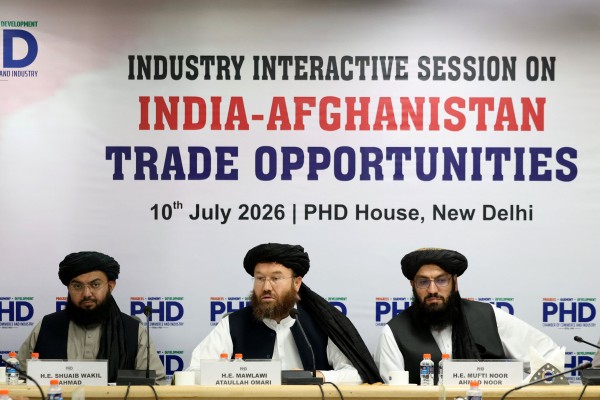
Afghanistan’s Minister of Agriculture, Irrigation and Livestock, Mawlawi Ataullah Omari, stressed the urgency of modernising the sector.
“Eighty per cent of our people are involved in agriculture and livestock. It is now the time to modernise them,” he said during a recent visit to India as part of a business delegation.
His priorities are practical: farm machinery, certified seeds, harvesting technology, crop protection, cold storage, packaging and food processing.
“We need help for harvesting, protecting the harvest, collecting the crops,” he added.
For a country where agriculture remains the largest source of employment, improvements in productivity could strengthen rural incomes, food security and exports.
Water management offers another important avenue for cooperation.
Afghanistan’s Chargé d’Affaires in India, Mufti Noor Ahmad Noor, said the country possesses significant water resources but lacks the infrastructure to manage them effectively.
“Afghanistan is an upstream country with significant water resources, but much of this water is not being managed effectively,” he said.
Highlighting Kabul’s drinking water crisis, he identified opportunities for cooperation in water supply, irrigation and related infrastructure.
India already has credibility in this area. The India-Afghanistan Friendship Dam in Herat remains one of its most visible development projects and provides a foundation for future cooperation in irrigation, watershed management and hydroelectric power.
This is also where India enjoys a comparative advantage.
Unlike China, whose regional engagement has focused largely on strategic infrastructure and resource access, India’s presence in Afghanistan has long been defined by development. Roads, schools, hospitals, power projects, scholarships and community infrastructure have generated goodwill that extends beyond geopolitics.
That distinction could become increasingly valuable as Afghanistan seeks partners capable of creating jobs and improving livelihoods rather than simply financing large infrastructure projects.
The wider strategic contest nevertheless remains unavoidable.
China has expanded its regional footprint through Pakistan’s Gwadar Port and the China-Pakistan Economic Corridor, while India has pursued alternative connectivity through Chabahar and the INSTC. Afghanistan sits at the intersection of these competing visions because of its location between South, Central and West Asia.
But recent events also underscore an important reality. Strategic influence cannot depend on a single piece of infrastructure.
The next phase of India-Afghanistan relations will therefore be shaped not by one port, but by a resilient network of trade corridors, air links, agricultural partnerships, water projects and technology cooperation capable of withstanding the geopolitical shocks that are becoming an enduring feature of the region.
The lesson is not that India should move beyond Chabahar. It is that India should move beyond dependence on Chabahar.