

Foreign News
Skyroot Launches India’s Private Space Era


India’s private space ambitions blasted into a new era on Saturday as Hyderabad-based Skyroot Aerospace successfully placed its Vikram-1 rocket into orbit, making India only the third country after the United States and China with a privately developed orbital launch capability.
The landmark Mission Aagaman lifted off from the Satish Dhawan Space Centre in Sriharikota at 12:05 pm after a brief planned hold, before flawlessly executing a sequence that culminated in six payloads being deployed into a nearly 450-km low-Earth orbit.
Minutes later came the confirmation everyone had been waiting for: “Orbit achieved. History is made.”
For India, it was far more than another rocket launch. It marked the moment privately built Indian rockets proved they can independently reach orbit, opening a new chapter for the country’s commercial space industry.
The 23-metre, four-stage Vikram-1 performed almost exactly as planned. The Kalam-1200 first stage powered the vehicle through the thickest layers of the atmosphere before separating cleanly. The payload fairing then peeled away, exposing the satellites to space. The Kalam-250 and Kalam-100 stages followed in sequence before Skyroot’s Orbital Adjustment Module, powered by a restartable 3D-printed liquid engine, completed the final burn and inserted all six payloads into orbit.
Named after India’s space pioneer Dr Vikram Sarabhai, Vikram-1 is the country’s longest monolithic carbon-composite rocket stage and showcases a suite of indigenous technologies, including carbon-composite structures, propulsion systems, advanced avionics, thermal protection and 3D-printed rocket engines.
Designed for the booming global small-satellite market, the rocket can carry up to 350 kg to Low Earth Orbit and 260 kg to Sun-Synchronous Orbit, positioning India as an emerging competitor in the fast-growing commercial launch business.
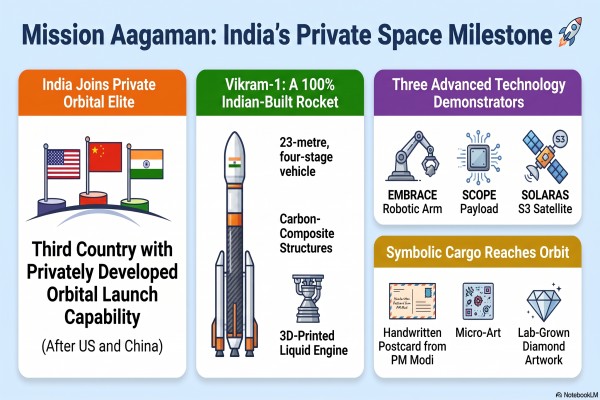
Among the payloads were several technology demonstrators, including Cosmoserve Space’s EMBRACE robotic arm for orbital debris removal, Skyroot’s SCOPE payload and Grahaa Space’s SOLARAS S3 satellite. The rocket also carried symbolic cargo, including a handwritten postcard from Prime Minister Narendra Modi bearing the words “Vande Mataram”, micro-art payloads and Cosmic Bloom, an artwork created using lab-grown diamonds.
Soon after the mission, Prime Minister Modi called Skyroot CEO Pawan Kumar Chandana and co-founder Naga Bharath Daka to congratulate them, describing the launch as a “historic new frontier” in India’s space journey and a powerful example of the country’s innovation and entrepreneurial spirit.
Responding to the Prime Minister, Chandana said the postcard carrying “Vande Mataram” had successfully reached orbit, adding that Vikram-1 was “100% built by Indians in India.”
IN-SPACe Chairman Pawan Kumar Goenka said the mission had exceeded expectations.
“The mission objective was simply to clear the tower. It went all the way up to a 450-km orbit and successfully completed every planned task, something far beyond expectations in a first launch,” he said.

Lt Gen. A.K. Bhatt (Retd.), Director General of the Indian Space Association, called the mission proof that Indian private industry can now execute complete end-to-end orbital missions, while Suhora Technologies CEO Krishanu Acharya said reliable domestic launch capability would dramatically improve the economics of deploying satellite constellations.
Former ISRO Chairman Dr S. Somanath described the launch as the arrival of India’s private rocket-building capability, built on years of policy reform and innovation.
Until recently, orbital launches from Indian soil were the exclusive domain of ISRO. Space sector reforms have since opened the field to private companies, allowing them to build launch vehicles, satellites and commercial space services.
Mission Aagaman is now the strongest validation yet of those reforms.
The success also strengthens India’s position in the rapidly expanding global market for dedicated small-satellite launches, where demand is rising for faster, lower-cost and more flexible access to space.
International investors have taken notice. Singapore’s sovereign wealth fund GIC co-led a funding round that boosted Skyroot’s valuation, while Temasek invested earlier. Ahead of the launch, Singapore High Commissioner Simon Wong hailed the mission as another example of India-Singapore cooperation “reaching for the stars”, coming months after both countries signed a space cooperation agreement covering research, Earth observation and satellite communications.
As Vikram-1 settled into orbit, Mission Aagaman became much more than Skyroot’s first orbital launch. It marked the moment India’s private space race truly left the launch pad.



