

Health
Physiotherapists reject plan to introduce diploma, technician cadres

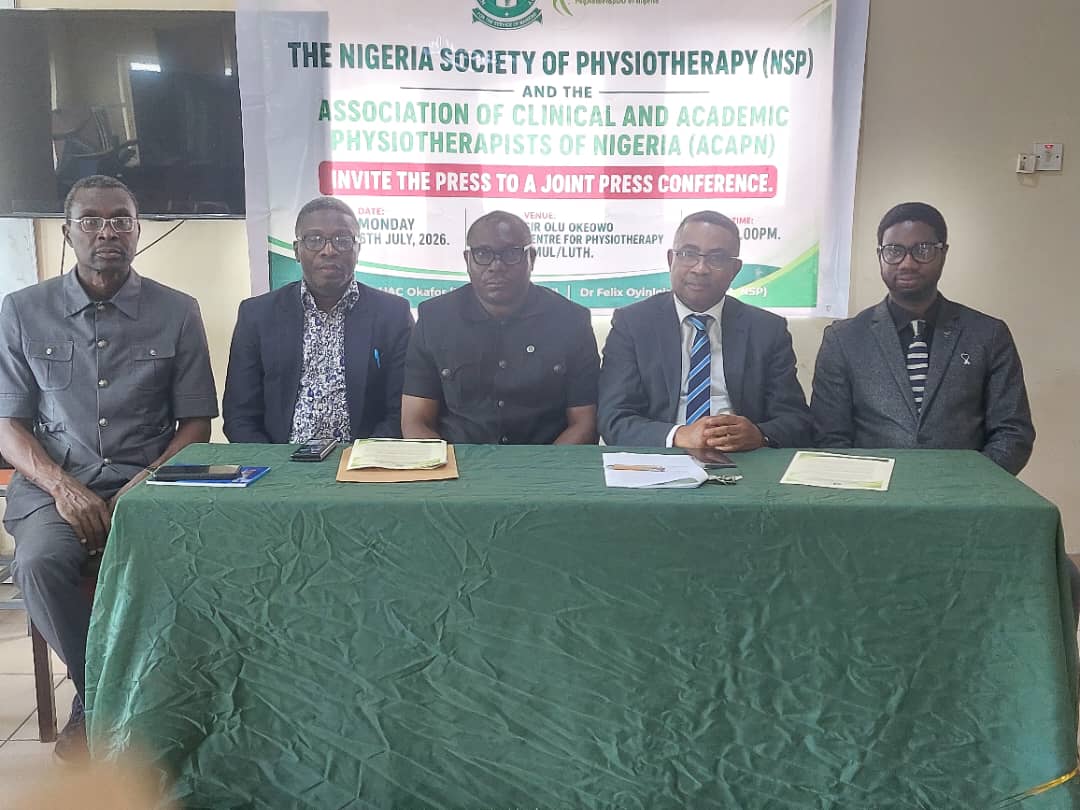
Physiotherapists have raised concerns over plans to introduce a diploma programme and a technicians’ cadre in physiotherapy, warning that the move could compromise patient safety and the quality of rehabilitation services in Nigeria.
The specialists argued that physiotherapy is a highly specialised healthcare profession that requires comprehensive university-level training to assess, diagnose, and manage patients with physical impairments and disabilities.
They cautioned that creating lower-level cadres without clearly defined scopes of practice could increase the risk of misdiagnosis, inappropriate treatment, and poor patient outcomes.
The experts made the call on Monday during a joint press conference of the Nigeria Association of Physiotherapy and the Association of Clinical and Academic Physiotherapists of Nigeria at the Lagos University Teaching Hospital, Idi-Araba, Lagos.
Speaking, the President of the Association of Clinical and Academic Physiotherapists of Nigeria, Prof. Udoka Okafor, said the plan to introduce diploma programmes as an entry qualification for physiotherapy practice in Nigeria would erode years of professionalism in the rehabilitation practices in the country.
He noted that the proposal, through the Medical Rehabilitation Therapists Board of Nigeria, including a plan to introduce a technician cadre, would greatly impact patient safety across the country.
“They are also proposing a technician cadre and diploma programmes, whereby people can undergo training for three months, six months, or two years as physiotherapy technicians and then be empowered to treat patients.
“We strongly reject this because we are deeply concerned about the welfare and safety of patients. There are critical areas of patient care where people who have not received adequate education in anatomy, physiology, pathology, and other aspects of medical training should never be allowed to manage. We are genuinely worried because our patients deserve better,” he said.
Okafor explained that it was surprising that years after the National Universities Commission approved the transition of physiotherapy education from a five-year programme to a six-year Doctor of Physiotherapy programme, the board is considering a diploma programme in 2026.
“In the 1950s, diploma programmes existed, but they were phased out in the late 1980s as the profession evolved from diploma-level training to university education. We are therefore surprised that, in 2026, people are advocating a return to the standards of the 1950s.
“The message is simple: we say no to diploma and technician programmes in physiotherapy. Whether it is called a technician programme, a diploma programme, or any other name, we reject it completely. All physiotherapists in Nigeria are saying no to it,” he said.
On his part, the President of the Nigeria Association of Physiotherapy, Dr. Felix Odusanya, said that while they support the move to introduce rehabilitation services in Primary Healthcare Centres across the country, deployment of non-physiotherapist cadres for the purpose may predispose patients to quackery.
Odusanya questioned why the MRTBN was proposing the deployment of non-physiotherapist cadres to provide clinical rehabilitation services when qualified physiotherapists remain unemployed and underutilised in Nigeria.

“Many of these qualified physiotherapists remain unemployed or underemployed, not because they are unwilling to serve in rural communities, but because Nigeria has not yet created a structured employment and deployment pathway for physiotherapists at PHC and community levels,” he said.
According to him, Nigeria does not need to wait three to five years to produce a new cadre before expanding rehabilitation into PHCs.
“The country already has a growing university-trained physiotherapy workforce that can be mobilised immediately. Current professional estimates indicate that Nigeria has over 80 active or emerging universities offering Physiotherapy or Doctor of Physiotherapy programmes.
“Annual output is currently estimated at 2,500 physiotherapists, with projections rising to about 8,000 physiotherapists annually within the next two to three years as new programmes mature and carrying capacity increases.
“With optimal utilisation of Nigeria’s existing rehabilitation workforce, the country can successfully implement Rehabilitation 2030 while protecting patient safety, professional standards, and the public interest,” Odusanya said.
The NSP president, however, proposes the deployment of qualified physiotherapists through internship, NYSC rehabilitation posting, PHC deployment, and permanent public sector absorption of physiotherapists.
“This model can begin immediately with unemployed and underemployed physiotherapists, while newly qualified graduates are channelled into PHC service through internship and NYSC. It is faster, safer, more lawful, and more sustainable than creating a new lower-cadre manpower pathway that may take years to produce its first graduates.
“Nigeria’s problem is not the absence of physiotherapists; it is the absence of a national deployment, absorption, and retention framework for physiotherapists at the PHC and community levels,” he said.
Copyright PUNCH
All rights reserved. This material, and other digital content on this website, may not be reproduced, published, broadcast, rewritten or redistributed in whole or in part without prior express written permission from PUNCH.
Contact: [email protected]



