

Foreign News
‘Appease China And You’ll Get Subjugation’

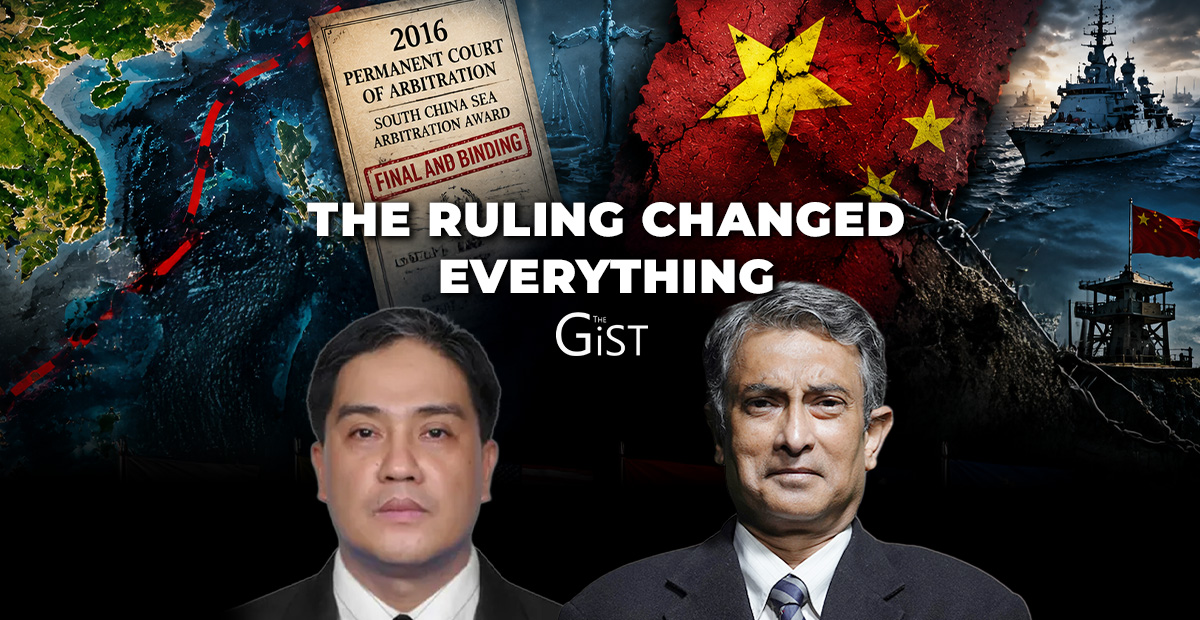
China’s rejection of the landmark 2016 South China Sea arbitration ruling did more than undermine international law. It exposed Beijing’s long-term strategic ambitions and fundamentally changed how countries across the Indo-Pacific viewed China’s rise.
That is the assessment of Dr Renato Cruz de Castro, Distinguished Professor of International Studies at De La Salle University in Manila, who argues that the ruling’s greatest legacy was not the legal defeat of China’s Nine-Dash Line claim but what Beijing’s response revealed about its intentions.
“The ruling revealed to us what kind of a great power China would be,” de Castro told StratNews Global. “China signed the agreement, but at the end of the day, it ignored that agreement.”
The Permanent Court of Arbitration ruled in July 2016 that China’s expansive maritime claims had no legal basis under the UN Convention on the Law of the Sea (UNCLOS). Beijing refused to participate in the proceedings, rejected the award outright and has continued to dismiss it over the past decade.
For de Castro, that decision became a defining moment.
“It basically opened our eyes to how China behaves as a great power,” he said. “One that will ignore international rules and norms, will never allow itself to be constrained, and has a very expansionist, revisionist undertaking.”
He argues that Beijing’s ambitions reach far beyond competing claims over reefs and islands. China’s objective, he says, is to dominate the First Island Chain—from the South China Sea to Taiwan and the East China Sea—and eventually displace the United States as the region’s principal maritime power.
“The goal is not simply resources,” he said. “China’s goal is to push the United States as the strategic offshore balancer in the region.”
According to de Castro, Japan was among the first countries to recognise what China’s rejection of the ruling signified. Tokyo’s subsequent military modernisation, he argues, was not a return to militarism but a response to an increasingly assertive neighbour. Australia, the United States, the European Union and, more recently, India have also come to view the arbitration award as a benchmark of China’s willingness to abide by international rules.
The Philippines reached the same conclusion, but only after first attempting accommodation. Former president Rodrigo Duterte initially sidelined the ruling in pursuit of closer ties with Beijing before reversing course after concluding that engagement had failed to moderate Chinese behaviour.
“Whether you appease or challenge China, you will get the same result—subjugation and expansion,” de Castro said.
That reassessment accelerated Manila’s military modernisation, including the acquisition of India’s BrahMos supersonic cruise missile system, which he described as providing the Philippines with a credible anti-access and area denial capability.

Looking ahead, de Castro believes the relationship between New Delhi and Manila should extend beyond defence exports.
“What will be important is a security partnership,” he said. “Not simply in terms of a commercial deal, but really a security partnership between two like-minded countries that are faced with a common security challenge—Chinese expansion.”
A decade after the UNCLOS ruling, de Castro believes its most enduring consequence is neither legal nor diplomatic. It is that countries across the Indo-Pacific now understand far more clearly what China’s rise means for the regional balance of power.



