

Health
Billions Spent, Millions Still At Risk: Why Nigeria Remains World’s Malaria Capital

Every time her three-year-old son develops a fever, Mrs Favour Okoh prepares for another round of medical expenses.
The 28-year-old resident of Kuchiako Extension in Kuje Area Council of the Federal Capital Territory (FCT) says malaria has become one of the biggest financial burdens facing her household.
Each episode forces difficult choices between buying food, paying school fees and paying hospital bills.
“We have treated him several times this year.
“Every visit to the hospital means paying for consultation, laboratory tests and medicines. Sometimes we do not have enough money, so we buy only part of the drugs or go to a nearby patent medicine shop.”
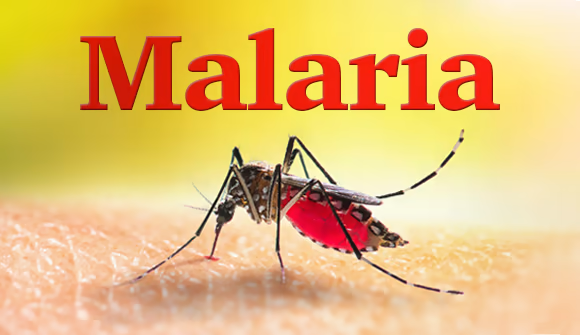
Around her neighbourhood, blocked drains, stagnant pools of water and heaps of refuse provide ideal breeding grounds for mosquitoes.
Although the family owns insecticide-treated mosquito nets (ITNs), using them consistently is difficult.
“When there is no electricity, it becomes too hot inside the net,” she laments.
For Okoh, malaria is no longer simply a seasonal illness. It is a recurring cycle that drains household income, disrupts family life and reflects wider challenges linked to poor sanitation, rapid urbanisation and unequal access to healthcare.
Her experience mirrors that of millions of Nigerians in spite of years of investments aimed at eliminating one of the country’s deadliest diseases.
Nigeria has nevertheless made notable progress.
National malaria parasite prevalence declined from 42 per cent in 2010 to about 15.2 per cent in 2025 following sustained investments in mosquito net distribution, improved diagnosis, effective treatment, seasonal malaria chemoprevention and stronger disease surveillance.
The progress informed the introduction of the National Malaria Strategic Plan (2026-2030), with government pledging closer collaboration with states, development partners, civil society organisations and the private sector.

The Chief Executive Officer of the RBM Partnership to End Malaria, Dr Michael Adekunle-Charles, notes that the decline in malaria prevalence shows that sustained collaboration can produce measurable results.
“This progress demonstrates that when governments, partners and communities work together, meaningful results can be achieved.
“While we celebrate this achievement, there is still much work to be done to ensure that every Nigerian is protected from malaria,” he says.
Notwithstanding the gains, Nigeria remains the world’s malaria capital.
According to the 2025 World Malaria Report, the country accounts for 24.3 per cent of global malaria cases and 30.3 per cent of malaria-related deaths.
More than 97 per cent of Nigerians live in areas where malaria transmission occurs, while children under five years and pregnant women remain the most vulnerable.
Experts say the contradiction reflects unequal progress rather than a failure of interventions.
The FCT illustrates this challenge.
According to the Mandate Secretary, Health Services and Environment Secretariat, Dr Adedolapo Fasawe, malaria prevalence in the territory declined from 18.8 per cent in 2021 to 7.9 per cent in 2025.
However, while districts such as Maitama, Asokoro and Wuse benefit from better drainage, sanitation and public infrastructure, communities including Kuje, Nyanya, Karu, Gwagwalada and parts of Bwari continue to battle blocked drains, stagnant water and inadequate healthcare, creating ideal breeding conditions for mosquitoes.
Public health expert, Dr Samuel Eleojo, says national averages often conceal communities where malaria transmission remains persistently high.
“The figures may look encouraging, but averages do not always reflect what is happening in every community.
“Some areas continue to experience repeated transmission because the environmental and social conditions driving malaria remain unchanged.”
Residents of many satellite communities say malaria remains part of everyday life, particularly during the rainy season.
Although millions of insecticide-treated nets have been distributed, many households do not use them consistently because of excessive heat, poor ventilation and unreliable electricity.
The persistence of malaria also raises questions about whether billions invested in malaria control have translated into equitable protection.
Between 2020 and 2024, the Federal Government secured 364 million dollars from the World Bank, African Development Bank and Islamic Development Bank to strengthen malaria interventions in 13 states, complementing support from the Global Fund, the U.S. President’s Malaria Initiative, WHO, UNICEF and other partners.
The investments funded mosquito nets, rapid diagnostic kits, antimalarial medicines, seasonal malaria chemoprevention, surveillance systems and health worker training.
A Health Economist, Dr Abigail Banji, says the challenge is no longer simply funding but ensuring equitable access to prevention and treatment.
Studies also show households still pay between 60 and 76 per cent of malaria treatment costs out of pocket because health insurance coverage remains limited.
For many low-income families, one malaria episode can consume a week’s income, forcing them to delay treatment or buy incomplete medicines.
Experts warn that delayed treatment increases the risk of severe illness, death and drug resistance.
Beyond the health burden, malaria is estimated to cost Nigeria about 1.1 billion dollars annually through lost productivity, school absenteeism and healthcare expenditure.
To reduce child deaths, the FCT Administration recently launched its 2026 Seasonal Malaria Chemoprevention campaign to protect more than one million children aged three to 59 months across the six Area Councils through monthly door-to-door distribution of preventive medicines.
Nigeria is also expanding the introduction of malaria vaccines for eligible children, although experts said reliable cold-chain systems, trained health workers and sustained financing will determine their long-term success.
Meanwhile, Lagos State is demonstrating the value of accurate diagnosis.
According to the Commissioner for Health, Prof. Akin Abayomi, malaria test positivity in public health facilities has fallen from about 60 per cent 18 months ago to around five per cent.
Abayomi coins the term “Wahalaria” to describe the widespread practice of treating every fever as malaria without laboratory confirmation, urging healthcare providers to test before treatment.
Prof. Olugbenga Mokuolu, Strategic Adviser on Malaria Elimination to the Minister of Health, says Nigeria’s next phase of malaria control must go beyond distributing mosquito nets and medicines.
He calls for improved drainage, better environmental sanitation, stronger primary healthcare services, wider health insurance coverage, uninterrupted supplies of medicines and diagnostic kits, increased domestic financing, stronger surveillance and greater community participation.
For families such as the Okohs, however, success will not be measured by national statistics or global rankings.
It will be measured by whether children grow up without repeated malaria infections, communities have functioning drainage instead of stagnant water, treatment is affordable and every Nigerian has access to effective malaria prevention and quality healthcare.
Nigeria’s progress proves malaria can be controlled.
Yet, until the benefits of investment reach the poorest and most vulnerable communities, the country will continue to bear the world’s heaviest malaria burden despite knowing how to prevent and treat the disease. (NANFeatures)
Edited by Vivian Ihechu



