Foreign News
China’s India Reset Masks Enduring Suspicion (2024-2026)
Before reading Part 2, catch up on Part 1 here : Galwan: China Changed Its Tone, Not Its Story (2020-2023)
Six years after the deadly Galwan Valley clash pushed China-India relations to their lowest point in decades, Beijing’s public narrative on India has undergone a striking transformation.
The accusations, sharp rhetoric and nationalist messaging that once dominated Chinese discourse have gradually given way to calls for cooperation, economic engagement and a more stable bilateral relationship.
Yet this apparent moderation should not be mistaken for a fundamental shift.
Between 2024 and 2026, Chinese state media increasingly emphasised dialogue, strategic autonomy, multipolarity and the benefits of improved ties. References to Galwan became less frequent, criticism more measured, and official coverage focused increasingly on economic cooperation and diplomatic engagement.
At the same time, nationalist voices continued to portray India as a strategic competitor. While official media promoted stability, online commentators frequently revived memories of Galwan, questioned India’s intentions and expressed hostility towards closer engagement.
The first signs of this shift emerged in 2024.
The year marked the most significant change in Chinese narratives on India since the Galwan Valley clash.
While strategic differences remained unresolved, official Chinese messaging increasingly focused on managing disputes rather than amplifying them. For the first time since 2020, Chinese media openly discussed moving beyond the prolonged freeze in bilateral relations.
A major indicator came in February 2024 following the 21st round of Corps Commander-level talks. Chinese state media highlighted both sides’ commitment to maintaining communication and pursuing a mutually acceptable resolution to outstanding border issues. Most notably, official statements called on the two countries to “turn the page” on the border situation.(Source China and India militaries to ‘turn the page’ – People’s Daily Online )
The phrase represented a significant departure from the language that had dominated Chinese coverage in the years after Galwan. Instead of revisiting questions of blame or sovereignty, official reporting increasingly stressed stability, dialogue and practical engagement.
The shift became even more visible in October 2024 after India and China announced a breakthrough understanding on border patrolling arrangements ahead of the BRICS Summit in Kazan. Chinese social media reacted intensely, with the hashtag “India and China Reach a Solution on the Border Issue” attracting more than 46 million views on Weibo. (Source: StratNews Global, October 2024, China’s Netizens Acknowledge Border Deal, Fault India, And A Veiled Warning – StratNews Global)
Yet the responses also revealed how Beijing wanted the deal interpreted. Many nationalist commentators viewed the breakthrough not as a Chinese compromise but as evidence of Chinese flexibility and restraint. Others linked the accord to wider strategic objectives, including preventing India from moving closer to the United States and strengthening cooperation within BRICS.
Chinese experts simultaneously delivered a subtle message to New Delhi: once progress had been made on the border issue, India should no longer allow the dispute to dominate the broader relationship.


Rather than focusing on confrontation, Chinese media increasingly framed improved relations as serving the interests of both countries and the wider region.
Criticism of India did not disappear, but it became less direct.
Instead of accusing India of provoking border tensions, Chinese commentary increasingly questioned New Delhi’s strategic calculations, particularly its ties with Washington. Analysts often portrayed the India-US partnership as transactional rather than ideological, arguing that New Delhi sought technology, investment and geopolitical leverage while preserving strategic autonomy.(Source: Global Times, 6 August 2024, What does the future hold for US-India ties? – Global Times)
Chinese commentary also continued to express concern over India’s role in South Asia. Articles in state media argued that New Delhi remained uneasy about China’s growing regional footprint and viewed neighbouring countries through a sphere-of-influence lens.
2025: Normalisation Gains Momentum
If 2024 was the year Beijing began repairing ties with New Delhi, 2025 was the year Chinese narratives increasingly reflected that change.
Coverage focused more heavily on economic cooperation, regional stability and the role of multilateral platforms such as BRICS and the Shanghai Cooperation Organisation.
Chinese scholars increasingly described India as an important player in an emerging multipolar order rather than viewing it primarily through the prism of China-US rivalry. Discussions surrounding Prime Minister Narendra Modi’s visit to China for the SCO Summit, his first since Galwan, reinforced this shift. (Source: As it stands, what is India’s position in the future global order?)
Perhaps the clearest indication of changing priorities came during the fifth anniversary of the Galwan clash in June 2025.
Unlike previous anniversaries, Chinese state media remained largely silent. There were no major patriotic campaigns, documentaries or extensive commemorations. The absence was striking. (Source : Slogans to Silence: Is China Burying Galwan Like Tiananmen? – StratNews Global)
Galwan had not disappeared from China’s narrative. It had simply been pushed into the background as Beijing prioritised stabilising relations with India.
Yet old habits persisted.
The announcement of China’s massive hydropower project on the Yarlung Zangbo, which flows into India as the Brahmaputra, triggered a wave of nationalist celebration on Chinese social media. Many commentators dismissed Indian concerns over water security and portrayed the project as a symbol of China’s technological strength and strategic advantage.(Source : https://stratnewsglobal.com/
Debates over China’s new K-visa programme for highly skilled foreign professionals revealed a similar undercurrent. Discussions quickly became intertwined with memories of Galwan, with some users openly arguing that Indians should be excluded from the scheme altogether. (Source:https://stratnewsglobal.com/china/no-indians-china-for-chinese-as-anger-over-k-visa-sweeps-social-media/ )
As the two countries marked 76 years of diplomatic relations, Foreign Minister Wang Yi declared that ties had returned to the “right track” and that the two countries shared more interests than differences.
State media echoed the message, arguing that stronger economic engagement would benefit both nations and contribute to regional stability amid growing global uncertainty.
Yet outside official channels, a very different narrative persisted.
On Chinese Social Media nationalist bloggers and military commentators continued to portray India as a strategic adversary. Some argued that China held overwhelming advantages along the border, while others questioned India’s strategic autonomy and depicted New Delhi as dependent on foreign military support.

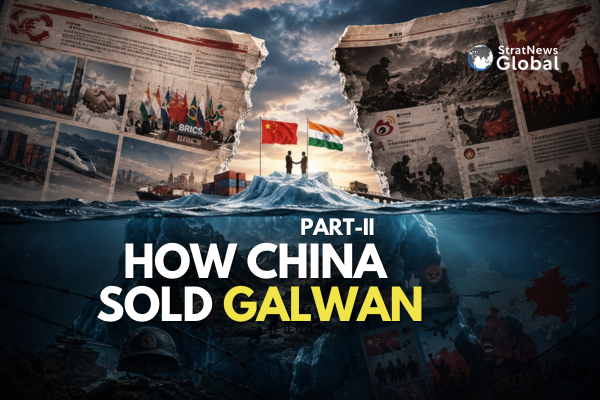
The contrast became even more visible in May 2026, when state media released a Mother’s Day video featuring the mothers of PLA soldiers killed in the Galwan clash. The campaign highlighted sacrifice and remembrance, demonstrating that while Beijing was pursuing better relations with India, Galwan remained a powerful symbol in China’s domestic political narrative. (Source: StratNews Global, May 2026China Weaponises Mothers Day With Galwan Imagery – StratNews Global)
Officially, Beijing spoke of cooperation, engagement and shared interests.
But among nationalist commentators and online audiences, suspicion of India remained deeply entrenched.
Read the third part of this series here (GOES LIVE ON 17th June 2026): Galwan’s Legacy: Thaw Or Tactical Pause? – Experts Take