Education
FAMU-FSU College of Engineering researchers create artificial intelligence tool to manage modern power grid

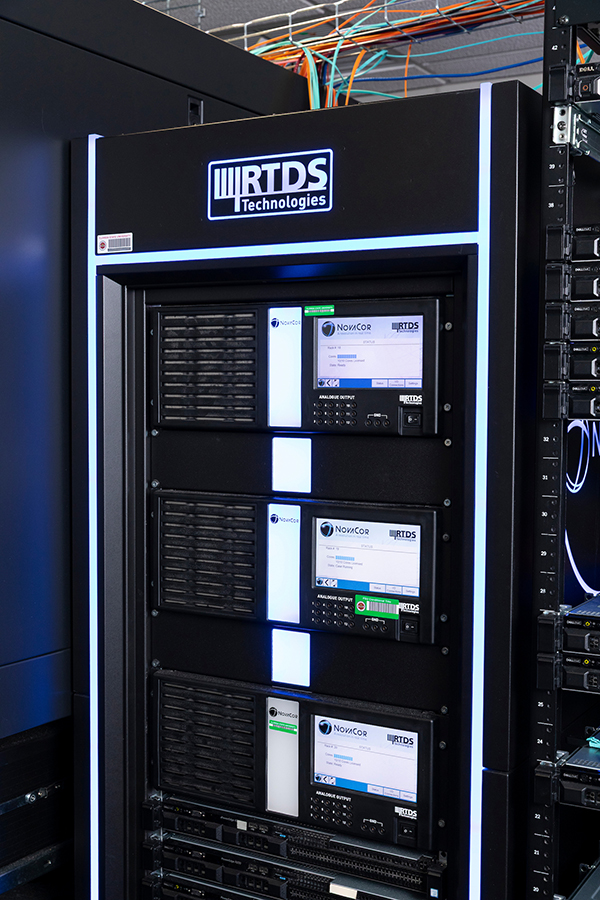
The Cyber-Physical Systems Security Group members, including (from left) Olugbenga Moses Anubi, Ph.D., Ravikumar Gelli, Ph.D., Abdulrahman Takiddin, Ph.D., doctoral student Quoc Bao Phan, and Tuy Nguyen, Ph.D., pose in the Simulation Lab with the NovaCor Real-Time Simulator at the Center for Advanced Power Systems in Tallahassee, Florida on July 27, 2026.
A new artificial intelligence tool developed by researchers at the FAMU-FSU College of Engineering and Florida State University’s Center for Advanced Power Systems could help make electric grids more reliable and reduce operating costs. The system improves forecasts of electricity demand and renewable energy generation, giving grid operators better information to balance supply and demand.
As more renewable energy comes online, today’s electric grid has become increasingly difficult to manage. Uncertainty in forecasts can force operators to keep too much reserve power, increasing costs, or too little, raising the risk of blackouts. The FSU-developed model addresses that challenge by treating the power grid as a connected network to generate more accurate forecasts. The research was published in IEEE Transactions on Network Science and Engineering.
The forecasting system, called GridFusionX, combines information such as past electricity demand, power generated from renewable sources, energy market prices and other data points to generate predictions and confidence intervals, helping operators run the grid more efficiently and with less wasted reserve power.

“Our research looks at smart systems as a dynamic puzzle: every factor, from different energy sources, to shifting demands in cities and changing prices and how they fit together,” said study co-author Tuy Nguyen, an assistant professor in the Department of Electrical and Computer Engineering. “What happens in one area can affect neighboring areas because they share power lines, weather patterns and energy markets. By continuously analyzing these pieces, we can predict energy needs more accurately and adapt to ensure both reliability and cost savings.”
How does GridFusionX work?
The main innovation in the AI tool developed in this research is multi-modality: the ability to use many sources of information in estimates.
“Whether we’re predicting power usage, traffic patterns or even weather, reducing uncertainty in our predictions lets us make smarter, more adaptive decisions that benefit daily life,” said Associate Professor Olugbenga Moses Anubi and a co-author of the study.
The system uses a graph neural network — a mathematical representation of connected objects — to map how what happens within one region in the power grid can affect neighboring regions. The tool addresses a critical gap in existing methods by providing both spatially connected predictions and measures of uncertainty.
The model’s precision allows grid operators to plan reserves more efficiently and respond proactively to sudden changes, such as spikes in demand or drops in renewable generation. In real-world tests across ten European regions, GridFusionX improved forecasting accuracy by up to 56% and cut reserve costs by as much as 66%, all while maintaining reliable service.
Why it matters
Today’s power grids have become increasingly complex. Regional power nodes are linked not just by electrical lines, but also by market economics, weather patterns and other issues that affect power usage.
“Right now, utility companies estimate your usage to make sure you never underpay, which almost always means you overpay,” Anubi said. “With our approach, predictions become more precise, so your bill matches what you truly use.”
Knowing how much energy is needed and when it is needed is a problem of predictability.
“The main vision is engineering intelligence,” said Associate Professor Ravikumar Gelli. “We want to help utility operator balance generation and load and help consumers pay less. That’s the vision behind it.”
A new generation of energy scholars
FAMU-FSU faculty are incorporating concepts used in this research into classes about cyber security systems for electric grids and artificial intelligence for power systems. Doctoral student researcher Quoc Bao Phan led the study.
“It benefits students to work on a project like this because they have the chance to work with four faculty instead of just one,” Anubi said. “This mentorship serves as a model for other students and other kinds of collaborations. There are good learning and research outcomes for students and that is also an important part of this project.”


Assistant Professor Abdulrahman Takiddin was also a co-author of this study. This work was supported by the FAMU-FSU College of Engineering.
Visit the FAMU-FSU College of Engineering website for more information about the research at the college. Visit the Center for Advanced Power Systems website to learn more about advanced power system engineering research at the center.