Education
FAMU-FSU College of Engineering researchers design magnetically levitated quantum bit

Researchers at the FAMU-FSU College of Engineering and the Florida State University-headquartered National High Magnetic Field Laboratory have designed new quantum computing architecture that uses magnetic levitation to smooth over design flaws in the intricate bits necessary to run a quantum computer.
Quantum bits, or qubits, can be as small as a few nanometers, and manufacturing them inevitably introduces random flaws onto their surface. By using superconducting magnets to levitate neon particles, the research addresses a challenge in electron-on-neon qubit devices: the tendency for electrons to become trapped by random tiny bumps on the neon surface, making them function unpredictably.
The study, published in the American Physical Society journal PRX Quantum, could help pave the way for more reproducible and scalable quantum computing technologies.
“Instead of hoping that the right nanoscale feature appears in the right place, we want to decide where each electron qubit sits,” said study co-author Wei Guo, a professor at Florida State University, the FAMU-FSU College of Engineering and the National High Magnetic Field Laboratory, or MagLab. “Magnetic levitation gives us a way to place a clean neon carrier above the chip, while the chip still provides the circuitry needed to control and read the qubit. In this architecture, the qubit is no longer found by chance. It is built by design.”
What they made: A new design for electron-on-neon qubits
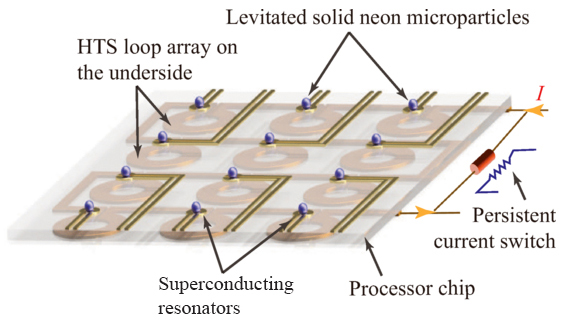
The researchers proposed a chip design that uses superconducting loops to magnetically hold tiny solid-neon particles above the chip surface. Instead of placing a solid-neon film directly on the chip, where it can inherit roughness from the substrate underneath, the new architecture uses nearly spherical neon microparticles as carriers for electron qubits.
“A simple way to think about it is that we give the electron a tiny, clean, floating island to sit on, rather than asking it to find a good spot on a rough landscape,” said study co-author Yinghe Qi, a MagLab postdoctoral researcher. “The chip underneath still provides the microwave circuits needed to control and read the qubit.”

Why it matters: Engineering a better chip
The work opens a path toward a new class of hybrid quantum devices, where clean quantum materials are integrated directly with chip-based control circuits.
“We have not built a full quantum computer in this paper, but we showed that the essential ingredients can work together in a realistic design: clean electron confinement, tunable qubit energy levels, strong coupling to microwave circuits and a way for neighboring qubits to communicate,” Guo said.
Technological advantages
Unlike the bits in ordinary computers, which store information as 0s or 1s, qubits use the rules of quantum mechanics to process information that can represent multiple possibilities at the same time until it is measured. To build a useful quantum computer, researchers need qubits that are clean, stable, controllable and practical to arrange in large numbers on a chip — a mix of properties that is difficult to achieve.
Electron-on-neon qubits, which use a single electron held above solid neon, are a promising platform for qubit design because of their accuracy and their ability to maintain their quantum information long enough to perform calculations. The electron sits in a clean environment, while the chip underneath provides the microwave circuits needed for control and readout.
The design shown in this study preserves the advantages of these qubits while using levitation to remove the randomness of a bumpy surface.
“The main advantage is reproducibility,” said study co-author Yiming Xing, an assistant professor in the FAMU-FSU College of Engineering. “Right now, useful electron-on-neon qubits depend on random nanoscale surface features, almost like hoping the right defect appears in the right place. Our approach replaces those random traps with designed, clean neon carriers placed at intended locations on a chip. If demonstrated experimentally, this could make electron-on-neon devices more predictable, reduce unwanted charge noise and make it easier to build larger arrays of qubits.”
Future research: Building a working prototype
The researchers plan to use their design to build a working prototype of an electron-on-neon qubit.
The main components of their design — superconducting loops, microwave resonators and patterned chip structures — are compatible with fabrication methods already used in quantum-device research, which will help researchers move from design to prototype and beyond.


Collaborators and support
Co-authors on this study included FSU postdoctoral researchers Sosuke Inui and Charles Peretti. Dafei Jin, an associate professor at the University of Notre Dame, was also a co-author.
The project received support from the FAMU-FSU College of Engineering, the National High Magnetic Field Laboratory and the Florida State University Quantum Initiative. The FAMU Center for Quantum Science and Engineering supported contributions by Xing and supported the Notre Dame team through the National Science Foundation ExpandQISE grant administered by Florida A&M University.