Education
FAMU-FSU College of Engineering researchers improve analysis of molecules linked to Alzheimer’s disease

Researchers at the FAMU-FSU College of Engineering and the National High Magnetic Field Laboratory have shown how higher magnetic fields can improve analysis of the molecules linked to Alzheimer’s disease, a finding that could aid the development of future treatments.
In a study published in Solid State Nuclear Magnetic Resonance, the researchers showed how a high-magnitude magnetic field can improve the accuracy of measurements that show the chemical composition of amyloid beta fragments, small pieces of proteins that have been shown to play a critical role in Alzheimer’s disease. They were able to analyze amyloid proteins even when they were structurally complex and mixed with lipids, creating conditions that more closely resemble the human brain than traditional laboratory samples.
By better understanding the composition and structure of these molecules, scientists can design compounds that may disrupt disease progression and lead to more effective treatments.
“The current treatment plans for Alzheimer’s disease are not working well enough,” said study co-author Ayyalusamy Ramamoorthy, a professor in the Department of Chemical and Biomedical Engineering. “This disease follows a complex process. We are looking into the mess of molecules implicated in memory loss, investigating how they promote toxic compounds in the brain and trying to stop them.”
How it works: finding a way to block Alzheimer’s disease
Researchers are still studying the exact mechanisms that cause Alzheimer’s disease, but amyloid beta proteins are believed to play a central role in the disease. These proteins are found clumped together among neurons inside affected brains. Studies have shown them to be a good benchmark for tracking disease progression and a potential target for treatment.
By mapping the structure of amyloid beta catalyzed by lipids, researchers can develop compounds that could effectively bind to its surface and fully stop them from killing neuronal cells within the brain.
“It’s like an incredibly complex puzzle piece,” Ramamoorthy said. “We want to create another puzzle piece that can match with it and stop it from binding with something within the brain responsible for memory.”

What they did
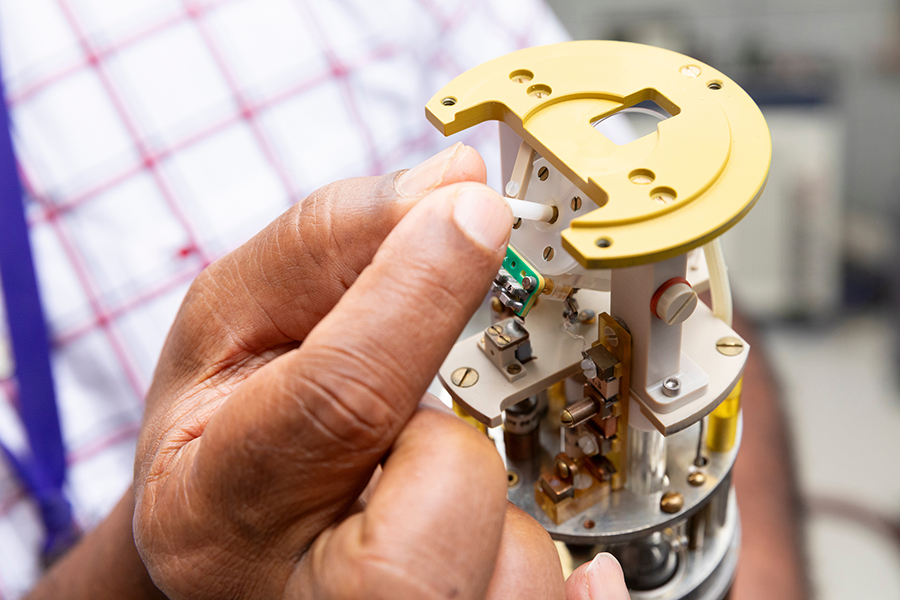
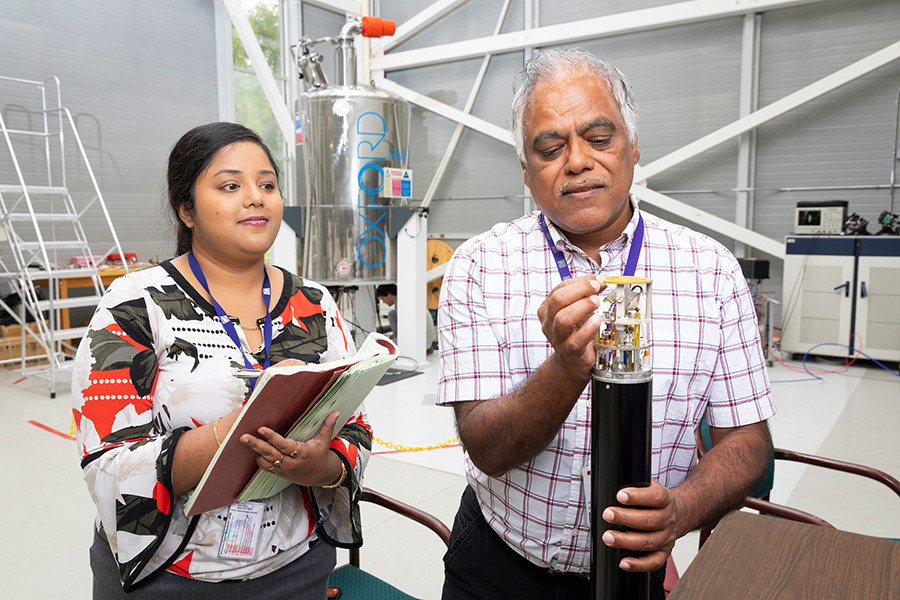
To find the edges of that puzzle piece, Ramamoorthy and the research team used a nuclear magnetic resonance (NMR) spectrometer. NMR spectrometers work by placing a sample in a strong magnetic field and applying radio waves to excite atomic nuclei. By measuring how the atomic nuclei absorb and re-emit these radio waves, scientists can determine properties like the chemical composition of molecules.
Instead of clean samples, researchers analyzed amyloid beta interacting with a lipid found in the membrane of neural cells. That emulated the tangled mix of cells found within the brain.
They measured samples with a 600-megahertz spectrometer and a 1,100-megahertz spectrometer and compared the results. Researchers already knew that a higher magnetic field would enhance the spectral resolution of amyloid beta proteins. This study showed that an NMR spectrometer using a higher magnetic field could also better identify discrete parts of amyloid beta within a realistic sample.
Even though the protein-lipid mix looks chaotic overall, the improved measurements revealed distinct, well-ordered segments within the combined samples and evidence of a central core inside amyloid proteins.
“When you have these amorphous collections of different cell types, they are not well-ordered. When you try to take a picture, it looks very blurry,” Ramamoorthy said. “We were able to zoom in and get a look at the structured regions within the protein.”
Why it matters and future research
The study shows that a higher magnetic field NMR spectrometer can identify information from amyloid proteins that exist in a diverse mixture of cell types. Scientists studying Alzheimer’s disease are no longer limited to ideal samples. They can study complex mixtures and still get atomic-level clues.
The researchers plan to use the National High Magnetic Field Laboratory’s 1.5-gigahertz NMR spectrometer for future research.
“This is the only place in the world where such an ultra-high magnetic field (1.5-GHz) NMR spectrometer is available,” Ramamoorthy said. “We want to push the challenges and overcome the hurdles in developing potential drugs to treat Alzheimer’s and related diseases, and these resources are crucial for this work.”


FSU postdoctoral researcher Jhinuk Saha and University of Wisconsin researcher Thirupathi Ravula were co-authors on this study. This research was supported by the National Institutes of Health (NIDDK), the National Science Foundation, and Florida State University. The research used NHMFL at FSU and the National Magnetic Resonance Facility at the University of Wisconsin.