

Entertainment
From hunger to hope: Lettie’s story on World Porridge Day


As the international community marks World Porridge Day on 10 October, the story of a young Malawian woman whose life was transformed by a daily school meal offers a reflection on the importance of school feeding programmes in the fight against hunger. Through the documentary Lettie, Mary’s Meals revisits a story first told more than a decade ago, tracing one woman’s journey from childhood hunger to hope.
By Francesca Merlo
When Mary’s Meals first met Leticia, known to many as Lettie, she was 11 years old. Recently orphaned and hungry, she had been forced to leave school and care for her two younger brothers. Her story was first shared in Child 31, the award-winning 2012 documentary that introduced audiences around the world to the reality of child hunger in Malawi. Now, more than a decade later, Mary’s Meals has returned to Lettie’s story.
Their new documentary, Lettie, shares a new, very different chapter of her life.
Today, Lettie is an educated, working mother. She works for Mary’s Meals Malawi, where she also serves as a Youth Ambassador, sharing the stories of children who, like her, receive a daily meal at school. Her son is thriving and neither he nor his mother are facing the hunger that once threatened to define her and her brothers’ futures.

A poster for Lettie’s Story
For Angela Chipeta-Khonje, Country Director of Mary’s Meals Malawi, Lettie’s story is both extraordinary and deeply familiar. “She is one of those children who went through hunger, but she overcame it thanks to a meal that she was getting every day at school”. However, Chipeta-Khonje notes, the significance of her story goes beyond survival. “It is a story that is giving hope to so many other children in Malawi,” she explains. “And it helps people understand the extent to which children are living in these situations.”
A daily meal, a lasting change
World Porridge Day, marked each year on 10 October, draws attention to the importance of school meals in tackling childhood hunger and improving access to education. The day is closely associated with the work of Mary’s Meals, which provides nutritious meals to children in some of the world’s poorest communities. Although the documentary was released earlier this year, Lettie’s story offers a reminder of the lasting difference that a daily meal can make in a child’s life.
For children in Malawi, the challenges of hunger and food insecurity are particularly acute. According to the World Food Programme, 6.8 million people in the country are experiencing insufficient food consumption. Most families rely on smallholder farming and rain-fed agriculture, leaving them especially vulnerable to droughts, flooding and other climate-related shocks.
“Food insecurity has remained a significant challenge,” Chipeta-Khonje explains. “Most families have been unable to recover from repeated climatic shocks and do not have adequate food production.” Children are often the first to bear the consequences. Yet, in the midst of these challenges, a simple meal can become something far greater than food. Mary’s Meals “is meeting immediate hunger needs,” Chipeta-Khonje says, “but it is also providing the incentive and energy for education, which ultimately breaks the cycle of poverty.”
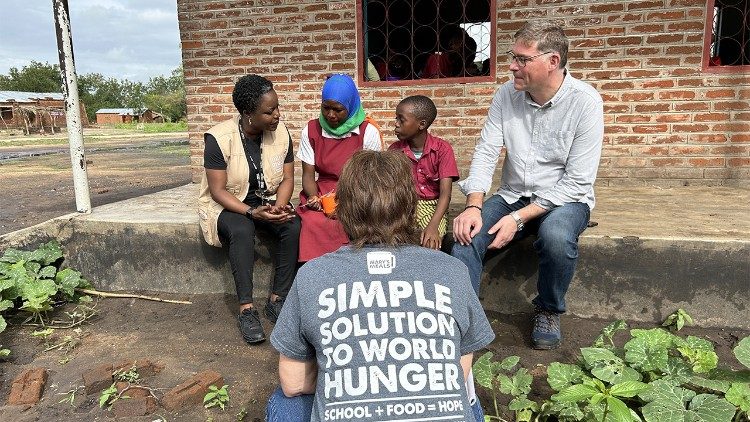
Anegla Chipeta-Khonje (l) talks to two children along with Mangus MacFarlane-Barrow (r), Founder of Mary’s Meals
More than a meal
Mary’s Meals began serving school meals in Malawi in 2003. What started with around 200 children in a single school has grown into the charity’s largest programme worldwide. Today, more than 1.3 million children receive a meal every school day across Malawi. They now operate in 16 countries worldwide. According to the organisation’s 2025 impact study, 97 per cent of teachers reported improvements in literacy and numeracy linked to better attendance and reduced hunger. Every teacher surveyed reported reduced dropout rates and improved retention among pupils receiving school meals.
Chipeta-Khonje says these outcomes reveal something important. “Yes, we are alleviating hunger,” she says. “But at the same time, it is an investment in human capital development.” Education, she argues, is one of the most effective ways of addressing the challenges many African countries continue to face. “We need a population that is educated so that we can deal with the challenges we are seeing every day.”

The many stories we do not hear
Lettie’s story has captured international attention because her journey was documented. But Chipeta-Khonje insists that “there are so many Letties out there”.
Over the last two decades, millions of children have passed through Mary’s Meals programmes in Malawi. Many have returned years later to share how a daily meal at school enabled them to remain in education, find employment, support their families and build better futures. For Chipeta-Khonje, these stories reveal the true power of school feeding programmes. “They create conditions for hope,” she says. “They create opportunity. They bring lasting change that is carried into adulthood and passed on to the next generation.”

Corn Soya Blend used to make the porridge
Small acts of love
Chipeta-Khonje hopes that as people watch Lettie all across the world, they will see more than one woman’s journey. She hopes they will recognise what can happen when people choose to respond to hunger with compassion. “It doesn’t have to be huge,” she says. “Small acts of love can do so much for so many children across the world”.
It is a message that resonates strongly on World Porridge Day. Behind the simple act of providing a daily meal are opportunities for children to attend school, receive an education and build a better future. Stories like Lettie’s remind us what this means in practice. Often, it means a future that once seemed impossible. As Lettie shows, a daily school meal may seem simple, but for millions of children, it can change everything.

Volunteers making porridge
Cover photo, poster, corn soya blend and volunteers making porridge all courtesy of Mary’s Meals
Source link



