Education
FSU geologists discover North, South American mammals mingled before continental connection



Florida State University researchers are part of an international team whose work reveals that North and South American mammals interacted before the Panamanian land bridge formed about 3 million years ago.
Professor of Geology and Environmental Science Yang Wang and geology doctoral student Chance Hannold are coauthors of a new study that challenges the long-held belief that North and South American mammals did not mix until the continents joined through an isthmus, a narrow strip that connects two larger land masses. Instead, the researchers found evidence of some North American animals clustering in present-day southern Mexico before opportunities arose to move further south beginning about 7 million years ago.
This research was published Thursday in the journal Science.
“Fossils, as well as ancient sediments and soils, provide valuable archives of past life and environmental conditions,” said Wang, who is also a faculty affiliate of the National Science Foundation-funded, FSU-headquartered National High Magnetic Field Laboratory. “By studying these natural archives, we can better understand how mammalian communities responded to past environmental changes and the processes that gave rise to present-day biodiversity patterns. This knowledge, in turn, can help us better anticipate the potential impacts of future environmental perturbations on the biosphere.”
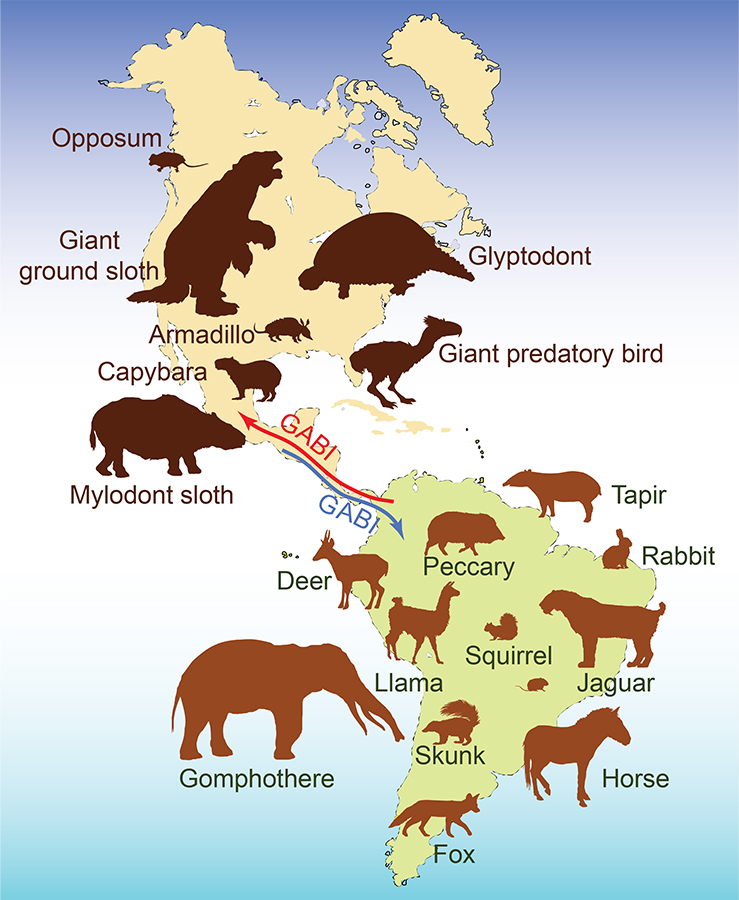
North and South America were once isolated continents home to distinct groups of animals. Until recently, scientists believed those animals moved north and south only after the Isthmus of Panama formed about 3 million years ago. Biologists refer to this as the Great American Biotic Interchange, or GABI.
However, the new research suggests many North American mammals migrated to present-day southern Mexico and remained there in a sort of geographical holding pen until the continents moved just close enough for smaller species, including racoon-like coatis, ringtails and rodents, to travel farther south, likely by island hopping through the Caribbean or rafting on vegetation.
This suggests that intercontinental species migration began at least 4 million years before GABI. For context: At the beginning of that 4-million-year gap, early human ancestors had just genetically separated from chimpanzees, and by the end of it, the Stone Age had begun.
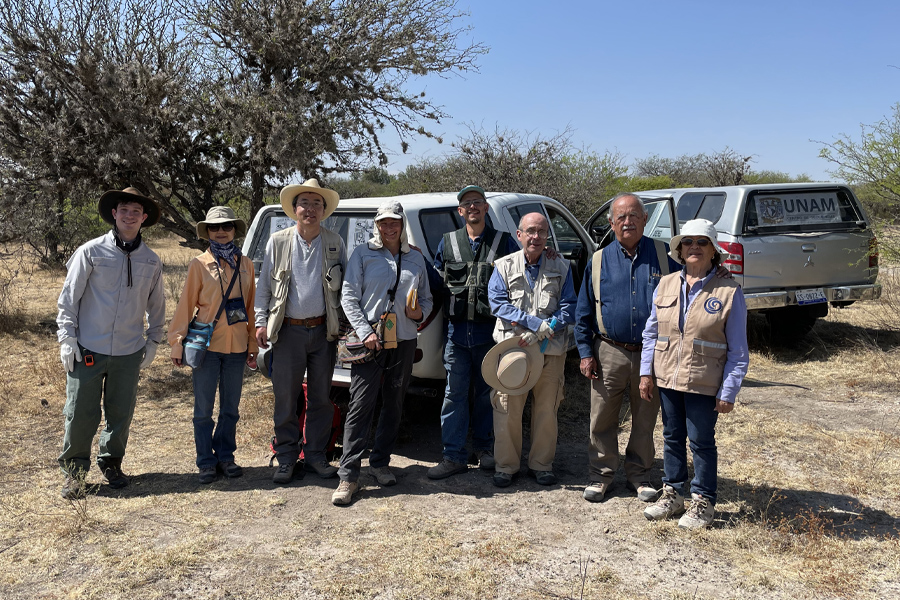
For this research, Wang and Hannold, a fifth-year doctoral student, conducted fieldwork in Mexico in from 2022 to 2024, collecting samples of ancient soil and fossilized tooth enamel.
“Earth’s natural processes, such as volcanism, the formation of the Isthmus of Panama, and the uplift of the Himalayas, have shaped the environments and climates in which animals, including humans, live,” Wang said. “We took our field samples back to the lab at FSU to conduct stable isotope analyses, which help identify when, where and in what conditions these animals lived, providing the environmental context for this study’s collection of fossils.”
Stable isotope analyses found evidence that the early arrival of North American mammals in Mexico was driven by the development of savanna grasslands in the region. The data revealed that C4 grasses — warm-season plants that include corn, sugarcane, switchgrass and Bermuda grass — were present in the area around 10 million years ago and became a dominant component of early horses’ diets by 5 million years ago.
“Yang’s new research is truly interdisciplinary, as it combines geological and biological evidence to investigate how geological processes created one of the great natural ecological mixing experiments of the Cenozoic Era,” said Mike Stukel, chair of the FSU Department of Earth, Ocean, and Atmospheric Science. “It is also fascinating to consider how these results might shed light on the current mixing experiment occurring as humans intentionally and unintentionally spread different species across the planet.”
Wang and Hannold’s work was supported by the National Science Foundation through a portion of more than $500,000 in funding for the project. The broader study was led by principal investigator Jack Tseng, an associate professor at the University of California, Berkeley, and coauthored by researchers from Stanford University, the Natural History Museum of Los Angeles County, California, and the U.S. Bureau of Land Management, as well as the Universidad Nacional Autónoma de México and Universidad Autónoma de Querétaro, both located in central Mexico.
To learn more about research conducted in the FSU Department of Earth, Ocean, and Atmospheric Science, visit eoas.fsu.edu.