Education
FSU scientists find gas emissions from rocks may have contributed to ancient climate swings, mass extinctions


An interdisciplinary team from Florida State University’s Department of Earth, Ocean, and Atmospheric Science has uncovered new evidence about processes that may have contributed to ancient mass-extinction events, some of the most dramatic ecosystem reorganizations in Earth’s history.
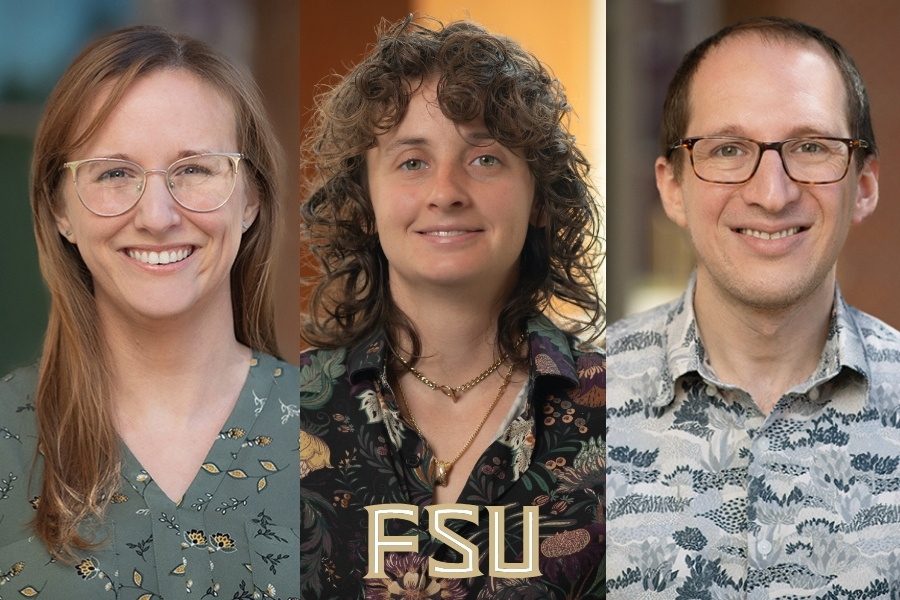
Assistant professor of meteorology Michael Diamond, assistant professor of geology Emily Stewart, and geology doctoral student Lindsi Allman combined deep-earth geochemistry and atmospheric science to show that natural sulfur and carbon released from metamorphic rocks affects the environment in similar ways to emissions from volcanic eruptions, long considered the primary drivers of mass-extinction events.
The study, “Metamorphic sulfur release as a driver of sustained cooling and mass extinction,” was published today in Science Advances.
“Evidence shows that the process that wipes out species is a climate swing, or an oscillation back and forth between hot and cold climates,” said Stewart, who researches the effects of metamorphic fluids on Earth’s cycles and long-term habitability. “Some extinctions are correlated with the timing of eruptions in large igneous provinces, which are massive magmatic areas that have seen lots of volcanic eruptions and lava spewing out of Earth’s surface. As long as geology as a field has existed, scientists have believed that volcanic eruptions and their emissions were the primary trigger for rapid global cooling and climate swings. We found another process that contributes to these events: metamorphism.”

How it works
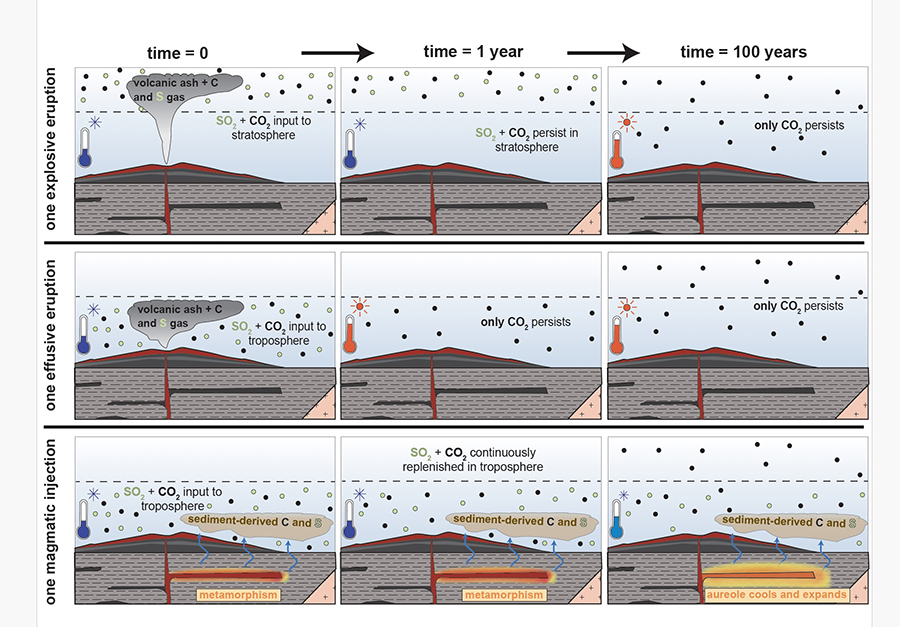
Metamorphic processes occur when rock under Earth’s surface is exposed to extreme heat, like when rock in large igneous provinces, such as the Ferrar large igneous province in Antarctica or the Siberian Traps in Russia, is heated by magma. If that rock contains sulfur and carbon, the heating process results in sulfur and carbon emissions, which allow them to seep out at the ground level as gases.
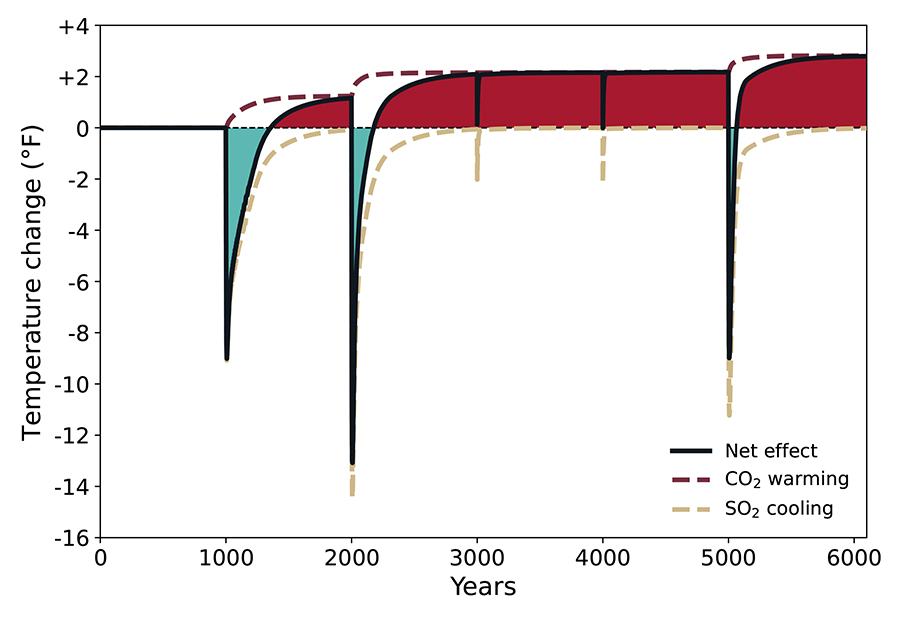
Sulfur emissions become sulfate particles in the atmosphere that act like tiny mirrors, reflecting some of the sun’s energy back into space. The Earth then absorbs less energy from the sun, leading to cooling spikes. Sulfates also act as “cloud seeds,” attracting water vapor to form clouds with liquid droplets that disperse water more efficiently and reflect more sunlight, also contributing to cooling spikes.
“Cooling spikes are the result of sulfur, which doesn’t stay in the atmosphere for more than a few days before dissipating,” said Diamond, who investigates how Earth’s climate is affected by cloud interactions with aerosols. “The opposite warming effect is due to carbon, which is also released in the metamorphic process but doesn’t react with other particles. Carbon remains in the atmosphere for hundreds, thousands or even millions of years. Even after sulfate-driven cooling spikes, the atmosphere is several degrees warmer than before due to carbon gas continually warming while sulfur aerosols cool and eventually disappear from the system.”
Ancient extinctions that may have been influenced by these emissions include the end of the Ordovician Period around 440 million years ago, when up to 85 percent of shallow marine species died, including many trilobites and corals. Another occurred at the end of the Devonian Period around 370 million years ago, when many marine species, especially reef-building corals and bony-armored fish like the Dunkleosteus, died out.
The end of the Permian Period, or the “Great Dying,” occurred around 252 million years ago and wiped out up to 96 percent of marine species and 70 percent of land species. Around 201 million years ago, the end of the Triassic Period eliminated many groups of giant reptiles that dominated land, sea and sky, making way for the rise of dinosaurs.
Why it matters
Although these events occurred millions of years ago, they provide natural experiments for investigating interactions and cycles among the solid Earth, atmosphere, oceans and biosphere. Understanding their causes helps scientists better understand the sensitivity of Earth systems to large-scale environmental change.
“Earth’s systems are deeply interconnected, and major environmental changes rarely result from a single isolated process,” said EOAS department chair Mike Stukel. “Scientific progress often comes from integrating geological observations, geochemical evidence, climate perspectives, and biological implications into a unified framework. This research demonstrates the value of bringing together expertise from multiple fields to better understand Earth’s past and its future, and it highlights why our department is such a special place.”
This work was funded by the American Chemical Society Petroleum Research Fund and several programs within the National Oceanic and Atmospheric Administration’s Climate Program Office.
“The more we study mass-extinction events, the more we see that they’re much more complex than we realized,” Stewart said. “In geology, we thought the question of what could drive ancient mass-extinction events was solved. The only way we broke this misunderstanding was by bringing in perspectives from another field, which pointed us to evidence that hadn’t been considered before.”
Visit the Department of Earth, Ocean, and Atmospheric Science website to learn more about research conducted in the department.