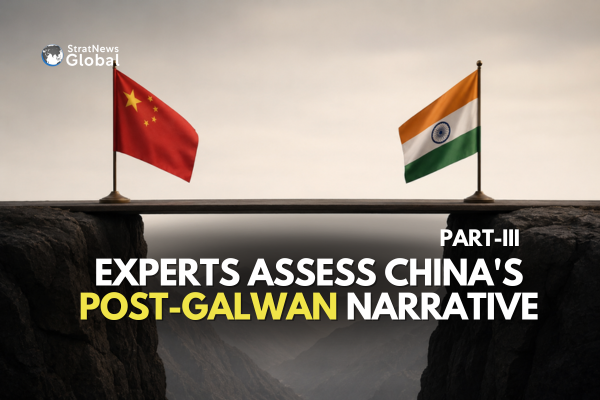
Six years after the Galwan clash plunged India-China relations to their lowest point in decades, a subtle but noticeable shift has emerged in Chinese official messaging. The strident nationalism and accusatory rhetoric that dominated state media coverage after 2020 have given way to a more measured tone, with greater emphasis on economic cooperation, trade and regional stability. But does this change signal a genuine strategic reset, or is it merely a tactical adjustment driven by shifting geopolitical realities?
To explore the question, Resham from StratNews Global spoke to two India-based China watchers: veteran journalist and former China correspondent Atul Aneja, and Dr Sriparna Pathak, Associate Professor of China Studies at the Jindal School of International Affairs, O.P. Jindal Global University.
Both agree that Chinese narratives towards India have become noticeably less confrontational since 2024. Where state media once portrayed India as the aggressor in Galwan and amplified nationalist sentiment, recent coverage has increasingly highlighted economic ties, connectivity and people-to-people exchanges.
Yet beyond that observation, their assessments diverge.
For Aneja, the shift reflects more than a change in messaging. He argues that Chinese state media generally mirrors the priorities of the Communist Party leadership, making the moderation in tone indicative of a broader policy recalibration. In his view, the current phase of “creeping normalisation” began after the meeting between President Xi Jinping and Prime Minister Narendra Modi on the sidelines of the BRICS Summit in Kazan in October 2024, their first face-to-face interaction since Galwan.
Aneja believes Beijing now sees value in stabilising ties with New Delhi. As competition with the United States intensifies, China would prefer India to continue championing multipolarity and strengthening forums such as BRICS and the Shanghai Cooperation Organisation rather than aligning more closely with Western-led strategic groupings. Economic considerations, he argues, are also encouraging a more pragmatic relationship.
Pathak agrees that the rhetoric has softened but is more cautious about reading too much into it.
In her assessment, the current warming is largely tactical rather than transformational. China, she argues, is navigating economic headwinds, growing strategic competition with Washington and the risk of pushing India further towards Western partnerships. Under these circumstances, reducing tensions with New Delhi serves Beijing’s immediate interests.
The contrast between these views captures the larger debate surrounding the future of India-China relations. Is Beijing undertaking a long-term reassessment of its approach to India, or simply adjusting its tactics to suit a more challenging strategic environment?
The answer may not lie in official statements or media narratives alone. Ultimately, the durability of the current thaw will be measured by developments on the ground, particularly along the disputed border. The real test is whether both countries can preserve stability in contested areas while expanding cooperation elsewhere.
As this three-part series has shown, the story of Galwan is no longer only about a deadly clash in a remote Himalayan valley. It is about how two rising Asian powers continue to navigate competition, coexistence and mistrust. Six years on, the border may be quieter, but the strategic questions raised by Galwan remain far from settled.
Read the part 1 of this series here: Galwan: China Changed Its Tone, Not Its Story (2020-2023)
Read the part 2 of this series here: China’s India Reset Masks Enduring Suspicion (2024-2026)