Foreign News
India-China To Explore ‘Early Harvest’ On Sikkim Border


India and China’s special representatives (SR) meeting in Beijing have agreed to “advance discussions on an Early and Substantial Harvest of boundary delimitation and Border Management. The first task for both these groups would be to agree on their respective Terms of Reference.”
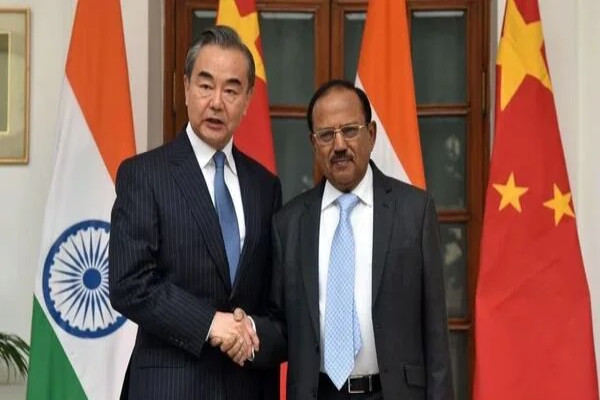
An “Outcomes” document issued at the end of talks between India’s NSA AJit Doval and China’s Foreign Minister Wang Yi (both represent the SRs designated by either country), also agreed on the need “to improve understanding of the Line of Actual Control in appropriate areas for better border management.”
Two more border meeting points are being identified in addition to the existing five (two in Ladakh, one in Sikkim and two in Arunachal), and two additional channels of border military hotline in the Eastern and Middle Sectors were agreed upon.
There will be a meeting on trans-boundary rivers next month and next year, the 26th round of SR talks will be held.
The big question: does the agreement on “early and substantial harvest” in Sikkim suggest India is moving away from its insistence on a “package approach”, meaning adjustments in the eastern sector linked to adjustments in the western sector?
Lt Gen Rakesh Sharma (Retd) who was corps commander in Ladakh over a decade ago, acknowledged that a “sectoral approach” towards the border was a change from India’s preference for a “package approach”, but this does not mean a breakthrough is imminent.
“I think to premature because there are several, irritants even now. As far as, let’s say, even if you talk about Sikkim being one of the early harvest, there are issues of the tri junction with Bhutan. There is there are other issues in central sector.”
But in his view, Sikkim “was not problematic” because its borders had been decided in 1898. Even so, to expect a quick breakthrough was not realistic.
Gautam Bambawale, former ambassador to China and high commissioner to Pakistan, told SNG that “The Chinese might be serious when they say ‘early harvest’ in the Sikkim sector, but India does not favour this ‘piecemeal’ approach to boundary resolution.”
In his view, “any movement will be small and incremental, so no great outcome can be expected in this prevailing situation, and no boundary resolution is around the corner.”
Gen Sharma argued that there was a need to look at the China relationship in very practical terms: India shares over 3000-km of border, more than $100 bn in trade. No purpose would be served if India linked progress in the China relationship as upsetting the balance with the US.
“Our relationship with the Chinese is separate and there are issues here which the United States is not involved at all. So we, we should have a separate relationship and develop separate modalities of discussing with the Chinese, including Chinese access to the Indian Ocean.”
The Chinese have had a presence in the Indian Ocean for quite some years and therefore “We need to be talking all the time,” he said, accepting that “There could be issues here but there are also positives in the form of trade.”

Bambawale warned that India is yet to overcome the distrust triggered by Beijing’s actions in the Galwan Valley in Ladakh in 2020.
The Chinese also say the border situation must not impact the rest of the relationship but when there’s no peace on the border, how will it not impact the broader relationship.
“They also say the two countries are partners in development, not rivals but the fact is we want to catch up with them, so there is rivalry,” Bambawale pointed out. “They are in our periphery and indeed in every part of the world.”
“Six years down and the two sides are yet to rebuild trust,” he said. The trust deficit is evident in the curbs India placed on the China relationship including on trade. Although some steps have been taken to address Indian industry’s need for Chinese raw materials and products, distrust is evident.
The Chinese do not want the boundary negotiations at the front and centre of the bilateral relationship, which India wants. Rather, they want the focus on opening up trade where their strength is evident in India’s growing deficit. How these dilemmas play out could determine the future of the India-China relationship.