

Politics
Inside Enugu’s multi-billion-naira surveillance centre with no


FROM a secure room in Enugu, operators can zoom into street corners, track vehicles, capture faces and dispatch security operatives within minutes. It is the centrepiece of Enugu State Governor Peter Mbah’s multi-billion-naira Safe City project, unveiled in 2024. But ICIR findings indicate that behind the promise of safety, a statutory gap exists; there is currently no law governing the surveillance centre. This raises several questions of accountability and possible abuse, specifically who accesses the footage and data, and how citizens can seek redress if they are wrongly monitored.
By Fidelis Mac-Leva
As soon as you step inside, the door hisses shut behind you, and the noise of Government House fades. What replaces it is a different, silent kind of power — the quiet, electric hum of a state watching itself.
This is the Command-and-Control Centre, the brain of the Enugu State Safe City Initiative of Governor Peter Mbah, tucked inside Government House in Enugu, the state capital.
The room is dark, deliberately so. The only light comes from a massive wall of screens — a glowing mosaic of Enugu. On one panel, traders at Ogbete Market haggle under afternoon sun. On another, headlights snake along the Enugu-Onitsha Expressway at dusk. Further down, a quiet schoolyard in Nsukka, a busy junction in Gariki, a farmland surrounded by thick forest in Ezeagu. It is the entire state, stitched together in real time, thanks to surveillance technology.
Beneath the screens, operators sit like pilots. Headsets on. Eyes flicking between camera feeds, incident logs, and a digital map of the 17 LGAs dotted with red, yellow and green alerts. Their fingers move over joysticks, zooming in on a crowd, panning a camera, logging an incident. The air is cold from the AC, but the tension is warm.
“This is where Enugu watches,” the Special Adviser to Governor Peter Mbah on Security, Vincent Onyeabor, says as he guides this ICIR reporter through the facility. “We monitor the city and all the LGAs, 24 hours. Not after a crime happens — before it escalates,” he added.
He points to an alert flashing amber on a screen. Within seconds, an operator zooms in. Another is already on the radio, dispatching a patrol team. On a side monitor, drone telemetry shows two quadcopters charging on the roof above.
It feels less like a government office and more like an air traffic control tower. Except the aircraft are citizens, vehicles, and emergencies.
Eyes on the streets
But the nerve centre in Government House is only half the story. The other half is outside, on the streets.
Enugu city has been wired with over a thousand CCTV cameras, mounted strategically at checkpoints and high-traffic areas. They sit atop tall poles at Zik Avenue, Ogui Road, and Okpara Avenue. They watch over traffic lights at Bisalla, Gariki, and Holy Ghost Junction. Others are installed at markets, bus terminals, and public buildings across the three senatorial zones.
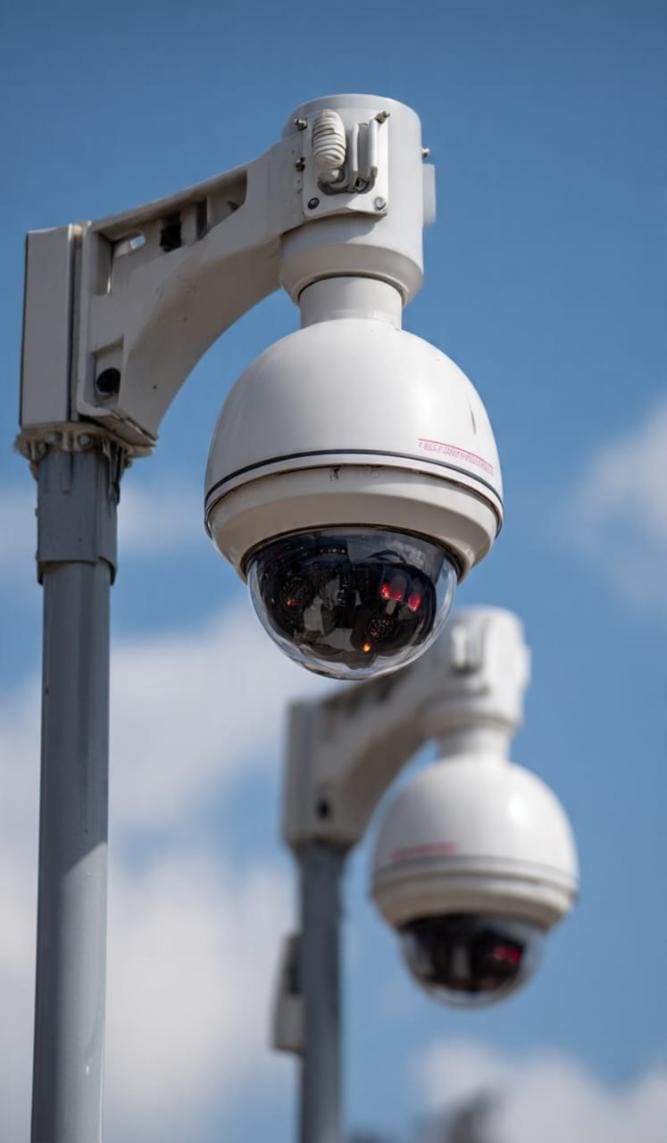
Most are sleek, white, weatherproof PTZ domes. By day, they swivel 360 degrees. By night, a faint infrared glow gives them away. Small signs beneath some read: “This Area Is Under 24-Hour CCTV Surveillance by Enugu State Government.”
“These are our first line of eyes,” Onyeabor explains.

“Every feed comes straight here via fibre. We can zoom from a wide shot of a roundabout to a single license plate. The AI can flag accidents, loitering, wrong-way driving, or unusual crowds and push it to this wall instantly.”
This reporter was awestruck when he pointed at my face on the ‘spy screen’ as I proceeded upon arrival at the Akanu Ibiam International Airport to the taxi parking lot. The reporter arrived on a Tuesday and visited the Centre on Thursday, two days later. I was informed that every new visitor has his/her face captured on the day of arrival.
Then comes the part that feels like science fiction. Behind glass, in neat bays, sit the state’s drones. Sleek, black, with thermal and zoom lenses.
“They take off from the roof of Government House,” the Special Adviser says. “In 10 minutes, they can be anywhere in the metropolis. For rural LGAs, they’re our eyes where we don’t have cameras yet. We can track movement in Ezeagu forests or along border routes in real time.”
The Secretary to the Enugu State Government, Chidiebere Onyia, a professor, frames it as more than hardware. “This is not just cameras and drones,” he told the ICIR. “It is a statement – Governor Mbah’s bet that security will be won not just with patrol vans, but with data, speed, and sight.”
The ICIR findings indicate that a network starts on a street pole in Enugu city, runs through fibre to this dark room, and can launch into the sky within minutes. It is, by design, a closed loop: see, decide, dispatch.
As the reporter left the Centre, the screens kept glowing. The cameras kept turning. The drones sat charging. Enugu was still being watched.
The billion-naira bet
Launched by Governor Mbah in 2024, the Enugu Safe City project was conceived as the flagship of the administration’s security and technology agenda. The stated aim was to move Enugu from reactive policing to predictive, technology-driven security across all 17 LGAs.
According to Governor Mbah, security remained central to his administration’s governance strategy since assuming office. He says the government invested heavily in surveillance technology, including a state‑of‑the‑art Command and Control Centre, and supporting infrastructure to ensure round‑the‑clock monitoring across the ‘Coal City’ state.
It is largely bankrolled through the Enugu State Security Trust Fund, a ₦20 billion public-private initiative set up to pool money for security infrastructure and operations in Enugu State.
Contributions are targeted from the State and LGs, corporate bodies, NGOs, religious bodies, and individuals in Nigeria and the diaspora, according to SSG Onyia.
The Board of Trustees, chaired by Ike Chioke, Group Managing Director of Afrinvest West Africa, and Chinedu Joseph Ani as Executive Secretary, was inaugurated on February 13, 2024, by Governor Mbah following the activation of the Enugu State Security Trust Fund Law that was enacted in 2020 and amended in 2023.
Although the SSG could not mention a specific figure, reports indicate that the sum of ₦3 billion was raised at its inaugural fundraising dinner held in October, 2024.
Government sources say the investment covers three pillars: a central intelligence hub, a city-wide CCTV network, and an aerial drone response unit.
A scrutiny of the Enugu State 2024 budget further shows heavy investment in surveillance, forensics, and police logistics — the core pillars of Safe City.
Although “Safe City” was not expressly mentioned, line items in the Enugu State 2024 budget reviewed by the ICIR indicate that security tech allocations totalled N4.657 billion. A breakdown shows that surveillance and monitoring got N940 million, with the rollout of actively monitored CCTV cameras across the state earmarked at N500 million.
Installation of 100 digital management cameras got N400 million; purchase of CCTV, metal detector, and bomb detector was allocated N30 million, and communication and tactical equipment was earmarked N200 million for two-way radios, body-worn cameras, GPS trackers, encryption devices, etc.
Forensics and data systems got 430 million for fingerprint databases and upgrades to ballistics and DNA labs, while aerial surveillance got N40 million for the acquisition of 20 drones.
These, the ICIR was informed, cover the “Eyes on the Ground” – the CCTV network on Zik Ave, major junctions, and LGAs linked to the Command-and-Control Centre; the “Response Link” — real-time coordination between field officers and the centre; and the “Eyes in the Sky” — drones for highways, forests, and border areas.
Similarly, the Enugu 2025 Budget allocated the sum of N10 billion for the installation of high-tech CCTV security AI cameras, drones and facial recognition for the command-and-control centre.
The state Commissioner for Budget and Planning, Chris-Roberts Ozongwu, explained during a budget breakdown that the high-tech CCTV security cameras and their searchlights would be placed at bus stops and junctions in highly densely populated areas and major highways in the state.
According to him, the latest technology-backed security system was meant to make the state safe and secure. He also said the cameras would be linked to a centralised monitoring system to effectively monitor and coordinate the entire security system in the state.
“The N10 billion CCTV is meant to position Enugu as the number one destination for net worth Nigerians and foreign investors to do business and live peacefully,” the commissioner said, stressing that the system includes ANPR, vehicle identification and facial recognition capabilities as part of the “Safe City” digital transformation.
“The objective is simple; we want zero tolerance for crime, faster emergency response, and data to guide policy. This centre is where it all comes together,” the SSG said.
According to him, Safe City is designed to achieve real-time crime prevention through 24/7 surveillance; faster emergency response by linking police, Air Force, and Army to one command hub; use of AI to identify crime patterns and guide deployment; and attract investment by making Enugu one of Nigeria’s safest cities.
Onyia explained that the impact is already measurable. “Violent crimes have significantly reduced by 80 per cent following the introduction of the project,” he told ICIR.
The state police command re-echoed this claim but did not provide comparative crime statistics when contacted.
“On assumption of office in 2023, Governor Mbah set security as one of his pivots to move our GDP from N4 billion to N30 billion over eight years. Building a state where investors feel secure requires security. Hence, he integrated Safe City through technology as a critical aspect of intelligence gathering.”
He added that human resources for the centre were drawn from different security agencies to assist with surveillance and analytics. “Safe City was to achieve a real effect of safety and give the people confidence that Enugu is now safe for investors and recreation,” Onyia said.
“This governor does not need to track people. His results show and tell the story of good governance. I don’t know that their phones are being tracked. To the best of my knowledge, tracking is not what our Safe City project is being used for. We don’t gag people,” he insisted.
Procurement
On procurement, the SSG told ICIR: “We did a selective procurement module. Yes, we could do an open bid, but when the tenders were submitted, we wanted to see who had a track record, experience and who could work with our budget…”
He did not disclose the successful vendor(s), and there are no publicly available data on the names of specific vendors or contractors that procured equipment for the project.
A Daily Trust report earlier noted that “Governor Mbah trusts the capabilities of local experts headed by a Kano-born engineer (unnamed) instead of contracting to foreign firms.”
The other side of the lens
While government officials sell Safe City as a tool for safety and development, the wide reach of the cameras, drones, and command centre has also sparked concerns among civil society groups, journalists, and opposition figures in Enugu State.
Several rights activists and lawyers who spoke to ICIR allege that the same infrastructure meant to fight crime is being used to monitor critics of the Mbah administration – an allegation the state government denied.
“Beyond security, there is a growing fear that the system is being used to track journalists, activists, and opposition politicians,” one Enugu-based lawyer told ICIR on condition of anonymity.
“Even surveillance CCTV cameras become tools for tracking when they shift from general public safety monitoring to following specific people, vehicles or activities over time. We have had cases where people were picked up hours after posting critical comments online, and the timing suggests they were located using CCTV or other tracking tools,” he said.
Case studies
Among the most cited examples is the case of Senator Chijinkem Ugwuanyi, a social media influencer known for political commentary on Facebook.
On January 15, 2026, Ugwuanyi posted a quote he attributed to the SSG, Onyia. According to police, the post says: “Let us remember this quote by SSG Enugu State: Some people are meant to be used to win elections while some are meant to be given appointments and political dividends.”

Chijinkem confirmed to the ICIR that he made the referenced post but claimed that it was misinterpreted by the SSG, who accused him of cyberbullying in a petition to the Enugu State police command.
On January 27, the state police command arraigned him at a magistrate court for “cyberbullying/stalking” under Section 24(2) of the Cybercrimes Act 2015 as amended. The charge alleged he “knowingly or intentionally forwarded or transmitted a bullying message” and posted it on his Facebook page.
The presiding magistrate ordered him to be remanded in Enugu prison, where he spent 50 days in detention before being released on bail.
Amnesty International condemned the prosecution, describing the charges as “baseless and politically motivated.”
“The sham trial based on bogus charges of Senator Chijinkem shows utter disregard for the rule of law and shocking intolerance of dissenting voices,” Amnesty said in a statement.
Ugwuanyi’s lawyer, Frank Agbowo, also questioned the remand, saying they had cited provisions of the Administration of Criminal Justice Law that empowered the magistrate to grant bail.
However, Onyia told ICIR he had to take the matter to court because the statement attributed to him by Chijinkem on Facebook did not originate from him.
Five months later, David Chinwendu Ani, an Enugu-based journalist, founder of Glintnews, and former ADC House of Representatives candidate, raised a separate alarm.
Ani alleged that on June 13, 2026, operatives of the Enugu State anti-kidnapping unit were tracking him, interrogating his associates, and monitoring Akanu Ibiam International Airport to intercept him, despite what he said was the absence of any stated offence.
According to him, officers had been making digital inquiries about his whereabouts.
“My fears escalated after an associate repeatedly contacted me seeking my exact location,” he said.
He told ICIR that some associates were arrested and interrogated regarding his whereabouts.
“Security operatives received intelligence suggesting that I intended to travel to Abuja through Akanu Ibiam International Airport in Enugu and subsequently deployed personnel to monitor the airport to intercept me,” he said.
Ani has since filed a fundamental rights suit at the Federal High Court in Enugu, asking the court to declare the alleged plot to arrest him without due process as unconstitutional.
Responding, the Enugu Police Commissioner, Mamman Bitrus Giwa, said it behoves Ani to have reported to the command with his lawyer to clear his name.
“For him to say the police are tracking him without him knowing his offence is already an admission of guilt. If you know you have not committed an offence and the police are looking for you, go and clear your name,” he said.
Comrade Emmanuel Acha, a human rights advocate and Chairperson of the Enugu State Civil Society Network, was allegedly picked up from his residence in Enugu in the early hours of March 19, 2025, by heavily armed security operatives.
Acha told ICIR that he was tracked and eventually arrested without an arrest warrant, handcuffed, and first taken to the Abakpa Area Command of the Nigeria Police in Enugu, from where he was transferred by another team who told him he was being taken to Abakaliki “on orders from above.”
“I was held incommunicado at the Ebonyi State Criminal Investigation Department, CID, denied access to family and legal counsel, and subjected to physical and psychological torture,” he said.
On March 21, 2025, he said he was arraigned before a magistrate court in Abakaliki without legal representation and remanded at the custodial centre. He spent 271 days in prison and described the conditions as severe, with overcrowding, poor sanitation, inadequate medical care, and routine abuse.
Ani told the ICIR that the charges against him included promoting communal violence, unlawful possession of firearms, murder and instigation of violence.
In December 2025, the High Court discharged and acquitted him of the charges.
His lawyer, Ikeazor Akaraiwe, a Senior Advocate of Nigeria (SAN), said: “The case collapsed because the prosecution could not establish any of the elements required by law. No weapons were acquired, no witnesses testified to any act of violence, and no evidence linked Acha to the crimes alleged.”
‘We are scared of critical reporting’
Some journalists in Enugu who spoke with ICIR on condition of anonymity said that, for fear of being watched, they now think twice before running critical reports that may not go down well with the state government.
“Since the Safe City cameras went up and the arrests started, we now think twice before we run critical stories. Not because the story isn’t true, but because you don’t know who’s watching the footage or if your car plate will be flagged leaving Government House,” says a journalist.
Similarly, an online platform publisher, who sought anonymity for fear of victimisation, said, “The surveillance technology itself is good for crime. But without a law, it feels like the line between tracking criminals and critics is blurry. A few of us now meet sources outside Enugu city to avoid being seen on camera.
An independent blogger, who stressed the need for a safer Enugu, said: “When you see colleagues picked up over Facebook posts, it is censorship. That’s not press freedom.”
Safe city or safe politics?
Opposition politicians have equally raised concerns about Safe City, alleging that the equipment is being used to monitor key figures, rallies, and strategy meetings ahead of the 2027 elections instead of focusing only on crime.
A chieftain of the PDP who asked not to be named said they were not against technology to fight crime in Enugu State.
“But what we are seeing is that the cameras and tracking tools meant for kidnappers are being used to monitor opposition meetings and track the movement of our members. With 2027 approaching, this Safe City project is looking more like a Safe Politics project. Kidnappings are still happening in Ezeagu, Udi, and some border communities. If the equipment cannot stop that, then what exactly is it for?”
Speaking in the same vein, Okagwu Okechukwu, a chieftain of the ADC, says: “Any time I decide to travel to my village, I go into fasting and prayers. The government told us the multi-billion-naira Safe City would end insecurity. Yet we are still having abductions. Our youth leaders are being invited for ‘questioning’ days after holding rallies. That tells you where the priority is. Before 2027, the people of Enugu deserve a law that governs how this data is used, who has access, and an independent oversight board. Without that, this is just mass surveillance.”
The government insists the project is not partisan. “Ours is strictly for the purpose intended — security,” Onyia said.
On data use, he said: “The data gathered couldn’t be used outside crime-related investigations or things that may infringe on the privacy or rights of citizens.
Legal red flags and the oversight gap
Legal experts say the biggest vulnerability of Safe City is not the cameras or any other equipment, but the absence of law.
This, they say, is predicated on the fact that the CCTV, ANPR (Automatic Number Plate Recognition), facial recognition and the central Command and Control Centre will collect massive personal data.
“Without a state law, defining warrants or oversight, there’s no clear rule on who can access footage, for how long it’s stored, or how citizens can request or delete their data,” says Emmanuel Acha, Enugu-based human rights activist.

He explained that footage from CCTV may be challenged in court if there’s no law authorising collection and storage, adding that defence lawyers can argue that it was illegally obtained.
The key questions asked by some lawyers are: Who authorises access to live feeds? Can police access footage without court order? Without law, this is now left to an MoU and internal policy, which can change.
According to the Rule of Law and Accountability Advocacy Centre (RULAAC) Executive Director, Okechukwu Nwanguma, activists’ cases like Acha and Chijinkem show how state actors can use security infrastructure against dissent, stressing that without a law, there’s no penalty for misuse of CCTV for political tracking.
Findings also reveal that there is currently no independent oversight board for the Safe City initiative, as only a law would create an oversight commission with civil society, judiciary, and legislature input.
What other states have done
Although the Nigeria Data Protection Act 2023 applies, every state is expected to localise and enforce penalties or appoint a state Data Protection Officer for Safe City data.
Findings show that in Lagos State, the Neighbourhood Safety Corps Law and the Lagos State Data Protection Law passed in 2016 have given legal backing to CCTV and C3.
Similarly, the Kaduna State Security Trust Fund Law 2017 gives legal backing, while Ekiti State also has a Security Network Agency Law enacted in 2020 in place.
Findings indicate that similar laws exist in Ondo, Edo, and Oyo states.
An Enugu-based opposition politician says: “Right now, Safe City in Enugu is running on political will – the ESSTF fundraising—not law. That makes it fast to deploy but fragile legally and politically.”
Uchenna Nnawuchi, an expert in AI governance, data protection and privacy, points out that Sections 24 and 25 of the Nigeria Data Protection Act 2023 require lawful processing, purpose limitation, and data minimisation – obligations that continue to apply even where national security concerns arise.
He notes, however, that those duties are meaningless unless there is a record capable of demonstrating compliance.
“There is no statutory requirement for comprehensive access logs, independent oversight, periodic review, or post-surveillance reporting,” he says.
“In a constitutional democracy, the state must not merely act lawfully; it must be capable of proving that it acted lawfully.”
Human rights and civil society organisations in the Southeast have also raised concerns about oversight, due process, and potential misuse.
They posit that without a state law regulating Safe City, the command centre and CCTV network operate in a legal vacuum.
“Who watches the watchers?” one activist asked, calling for an independent board, with CSO and legal representation, to audit access logs and approve requests for footage.
On data retention and privacy, some activists say there is no clear policy on how long footage is stored, who can download it, or how it’s shared with other agencies, warning this creates room for abuse.
An Abakaliki-based lawyer argues that arrests linked to social media posts, like Ugwuanyi’s, show a reliance on the Cybercrimes Act to punish free speech. He enjoined Enugu State to domesticate clear rules on digital surveillance to align with the 1999 Constitution.
Findings show that there is currently no public channel for citizens to find out if they are being tracked, to request footage, or to report abuse of the system.
According to Nnawuchi, there is a structural cruelty in a legal system that guarantees the right to privacy but provides no mechanism by which the violation of that right can be discovered.
“The wall that Section 37 of the Constitution of the Federal Republic of Nigeria 1999 (as amended) erects between the citizen and the surveillance state is real as a matter of constitutional text. But a wall with no windows, and no way of knowing whether the other side is occupied, protects the inhabitant in name only,” he says.
“The citizen who suspects that their phone is being monitored stands behind that wall with no instrument to confirm the intrusion and no legal process to compel confirmation from those who may be conducting it. The short answer is that, in most cases, ordinary citizens cannot reliably determine whether they are being surveilled.”
Our hands are clean—Enugu Police
CP Giwa absolved the police of human rights violations in their tracking process.
“My officers and men are well trained to perform their duties without running foul,” he says. “The police and DSS carry out the tracking even at the command-and-control centre. To the best of my knowledge, my officers are doing their surveillance job professionally,” the CP says.
On legal procedures followed, he said he was not in a better position to respond.
“The police are not in charge of this; we only carry out coordinated arrests. The persons who are directly in charge should respond to this.”
Civil liberties organisations and local journalists say the visibility of cameras, drone patrols and high-profile arrests is already causing self-censorship in Enugu as people are being extra cautious not to incur the wrath of state authorities.
The groups ask Governor Mbah’s government to enact a Safe City/Surveillance Law that defines purpose limitation, data protection, and penalties for misuse; set up an independent oversight commission with CSO, NBA, and media representation. They also call for the publication of an annual transparency report on the number of arrests, types of incidents flagged by AI, and requests for footage by police; and train operators on human rights to prevent profiling based on politics, ethnicity, or activism.
No law in place yet, says Enugu Attorney General as Speaker keeps mum
Osinachi Peter Mbah, the Enugu State Attorney General, confirms the absence of a law backing the Safe City project, saying, “We are still working on a draft legislation.”
According to him, the Nigeria Data Protection Act 2023 suffices for the Enugu Safe City project. “Everybody protects themselves under that law,” he says.
Asked how the national law would cater for local needs, Mbah says: “The scope of work we are doing will expand, which is why we need a local law from the perspective of what our security architecture is going to be doing.”
Uche Calistus Ugwu, Speaker of the Enugu State Assembly, failed to respond to several calls and WhatsApp messages sent to him for comments. On Thursday, August 13, 2026, several calls were successfully connected to him, but he did not respond. On Saturday, August 15, a WhatsApp message was sent to him, but he failed to respond. By press time, several calls made to him were unanswered.
A member of the Assembly who sought identity protection because he is not authorised to speak on the matter told the ICIR that the Assembly has yet to receive a draft law on the Safe City project.
What we have documented—RULAAC
Okechukwu Nwanguma, Executive Director of RULAAC, says the organisation observed a disturbing pattern of shrinking civic space in Enugu State.
“Over the past three years, we have received complaints from journalists, human rights defenders, lawyers, political actors, and ordinary citizens alleging surveillance, arbitrary arrests, intimidation, and the misuse of criminal law to silence dissent,” Nwanguma says.
According to him, the trend became more noticeable following the 2023 political transition, particularly around reporting on insecurity, enforcement of sit-at-home orders, and politically sensitive developments. “Rather than subsiding, complaints have continued through 2024, 2025 and into 2026. The fact that RULAAC petitioned the Inspector-General in July 2026 and subsequently requested an update because allegations persisted indicates that these concerns remain current,” he says.
Nwanguma added that documented specific tactics include phone tracking, surveillance, arrests, and intimidation of family members, as well as arbitrary arrests without prior invitation or warrant, including confiscation of phones and other digital devices.
Our Safe City is not about politics—SSG
The SSG maintains that the project is not about politics. “Safe City is not a surveillance project against citizens,” Onyia said. “It is strictly a crime prevention and emergency response initiative designed to protect every resident of Enugu State.”
He reiterated the economic argument. “Recall that on assumption of office in 2023, Governor Peter Mbah set out security as one of his pivots to work on our economic growth plans aimed at moving our GDP growth from N4 billion to N30 billion in over eight years. He was very clear from the beginning that building a state where investors will feel secure to put in capital requires security.”
On data privacy, he said that from the very outset, the governor made it clear that it was non-negotiable. “This means that the data gathered couldn’t be used outside crime-related investigations or things that may infringe on the privacy or rights of citizens.”
He dismissed red flags raised by opposition figures and rights activists.
“We are in a political dispensation, but it is important to present opinions as such. All over the world, people in opposition sometimes raise red flags where there are none.
“The governor is very focused on a safe city where technology is used. Ours is strictly for the purpose intended — security,” he said.



