Foreign News
‘It’s Theatre, Not Surrender’: Hamas’ Gaza Power Play

At first glance, Hamas’ announcement that it will dissolve its Gaza government and transfer civilian authority to a committee of technocrats appears to mark the end of its 19-year rule over the enclave.
In reality, it is a political adjustment rather than a surrender.
“Hamas sort of dissolving its government is at best theatre. It is political wrangling, it is posturing,” says Kabir Taneja, Executive Director, ORF Middle East.
The proposal is linked to the US-backed post-war plan for Gaza, which envisions a technocratic administration to oversee reconstruction.
Hamas says it is prepared to step away from civilian governance, but Israel insists the move is meaningless unless the group also disarms. Until that question is resolved, the proposed transfer of power is unlikely to change realities on the ground.
“Hamas is not technically declared defeated in Gaza. In fact, assessments say there are still 4,000 to 5,000 Hamas fighters in Gaza. The disarmament of Hamas hasn’t gone to plan,” Taneja points out.
Those surviving fighters explain why Hamas believes it cannot be sidelined from Gaza’s future. After nearly three years of war, governing schools, hospitals and municipal services has become a burden, while retaining military capability remains its main source of leverage.
That is the central limitation of Hamas’ offer. It is giving up administration, not military power. At the same time, it has little appetite for another full-scale Israeli offensive.
“What Hamas also can’t afford beyond this point is a renewed bombardment to the levels that it was prior to President Trump basically asking or forcing Netanyahu to stop,” Taneja says. “The Board of Peace, which has reconstruction at the centre of it, is also in the deep freeze.”
With reconstruction stalled and no agreement on Gaza’s post-war future, the proposed technocratic administration cannot take over.
“At this point of time, I think the idea for Hamas is to both not get embroiled in Gaza being bombed into smithereens again, but also try to remain as much in power as possible, specifically when it comes to Gazans,” Taneja argues.
The move also reflects Hamas’ belief that it retains support despite the devastation in Gaza.
“It is very difficult to always assess support,” Taneja says, pointing to the huge crowds at Ayatollah Ali Khamenei’s funeral in Iran. “It showed that not everyone in Iran is against the regime. I think a similar exercise also is there in Gaza for Hamas. Hamas does have some support.”

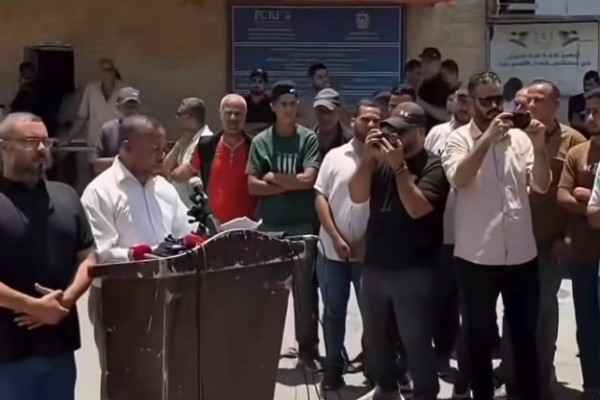

Political influence in Gaza has never depended solely on holding office. Even if a technocratic administration assumes civilian functions, Hamas could continue to wield influence through its armed wing, political networks and local support.
That is why Taneja sees Hamas’ announcement as tactical rather than transformative.
“The dissolvement and all that is basically as important as Mahmoud Abbas as the president right now. It’s a lot of theatre without any actual real-world power or influence to have the ability to move the needle on the crisis,” he concludes.