Foreign News
Jaishankar Meets Wang Yi, Sets India’s Terms


India has begun laying the groundwork for a busy summit season.
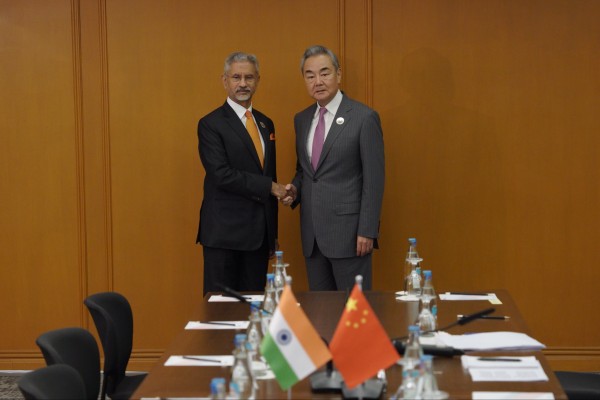
On the sidelines of the East Asia Summit (EAS) and ASEAN Regional Forum (ARF) in Manila, External Affairs Minister S. Jaishankar held a series of bilateral meetings with key partners, including Chinese Foreign Minister Wang Yi and Russian Foreign Minister Sergey Lavrov.
The discussions helped lay the diplomatic groundwork for the Shanghai Cooperation Organisation (SCO) summit and the BRICS Summit, while reinforcing India’s message that engagement with China must be matched by progress on border stability and economic reciprocity.
His meeting with Chinese Foreign Minister Wang Yi came at a significant moment. India and China have made steady progress in restoring bilateral ties since Prime Minister Narendra Modi and President Xi Jinping met in Kazan in October 2024, a process that gathered further momentum after their subsequent meeting in Tianjin.
“Our participation in the EAS and the ASEAN Regional Forum not only provides an occasion to exchange views collectively, but also hold this bilateral meeting,” Jaishankar said in his opening remarks. He added that the talks would provide an opportunity to review bilateral ties while exchanging views on major regional and global developments.
The SCO summit next month and the BRICS Summit under India’s chairmanship in September are expected to bring the two countries into sustained high-level engagement against an increasingly uncertain geopolitical backdrop.
Jaishankar thanked China for backing India’s BRICS presidency and its initiatives under the grouping.
“India is the chair of the BRICS this year. Let me take the opportunity to appreciate the support that China has given to various BRICS activities and initiatives during our chairship,” he said.
At the same time, he made clear that improving ties remain conditional on continued stability along the Line of Actual Control (LAC).
Reviewing bilateral relations, Jaishankar said ties have been “gradually normalising” since the Kazan meeting.
“Since the meeting of the two leaders in Kazan in October 2024, relations between India and China have been gradually normalising. This direction was further affirmed when they met in Tianjin last August,” he said.
He reiterated India’s longstanding position that a stable relationship with China must rest on three principles: mutual respect, mutual interest and mutual sensitivity.
“Such a relationship can make a valuable contribution to a multi-polar Asia and a multi-polar world,” he added.

The remarks reflect cautious optimism after India and China completed disengagement at Depsang and Demchok, the last remaining friction points in eastern Ladakh following years of military and diplomatic negotiations. Yet New Delhi continues to view lasting peace along the border as the essential foundation for broader normalisation.
Jaishankar also called for continued support to diplomatic and military mechanisms overseeing border management. Acknowledging that differences are inevitable between two large neighbours, he recalled the understanding between Prime Minister Modi and President Xi that disagreements should not be allowed to become disputes.
The economic agenda remains equally important.
While welcoming the resumption of direct flights, updated visa arrangements, the restart of the Kailash Manasarovar Yatra and the reopening of border trade, Jaishankar underlined that fair market access, trade imbalances and supply-chain resilience remain key concerns for India.
He also called for meetings of bilateral mechanisms and institutional dialogue platforms to be finalised in line with mutual priorities.
The message was unmistakable: diplomatic normalisation may be gathering pace, but India expects tangible movement on economic concerns alongside sustained stability on the border.
Jaishankar’s Manila diplomacy also extended to Russia, where he met Foreign Minister Sergey Lavrov following the attack on the merchant vessel MV Golden Leo, which killed four Indian seafarers.
Sharing details of the meeting on X, Jaishankar wrote: “An in-depth review of our bilateral relations with FM Sergey Lavrov of Russia. Reiterated our strong concern regarding the safety of Indian seafarers in the region.”
The two ministers reviewed cooperation in trade and investment, energy, connectivity, science and technology, and mobility, while also exchanging views on the Ukraine conflict and the evolving situation in the Gulf.
The meeting came a day after the Ministry of External Affairs summoned Russia’s Chargé d’Affaires in New Delhi to convey India’s “grave concerns and unequivocal condemnation” over the July 19 attack on MV Golden Leo.
According to the MEA, the Guinea-Bissau-flagged grain carrier came under attack while departing Ukraine’s Odesa port. Four Indian crew members were killed and another sustained critical injuries.
The ministry said attacks on commercial shipping undermine the safety, security and stability of international maritime commerce, stressing that protecting civilian shipping and freedom of navigation remains a priority for India.
Taken together, Jaishankar’s engagements in Manila highlight New Delhi’s broader diplomatic approach ahead of two major multilateral summits. India is expanding cooperation where interests converge, while continuing to press its concerns on border stability, economic reciprocity and the safety of its citizens.
Rather than pursuing normalisation for its own sake, New Delhi is signalling that stronger partnerships must be built on concrete progress in areas that directly affect its national interests.