

Entertainment
Madrid: Awaiting Pope Leo’s arrival and a revitalization of the faith


Fifteen years after Pope Benedict XVI’s World Youth Day in Madrid, Pope Leo XIV travels to the same city, where people hope for encouragement and a revitalization of the country’s faith.
By Kielce Gussie – Madrid
Tomorrow, the city of Madrid will welcome Pope Leo XIV for the first leg of his Apostolic Journey to Spain. Final preparations are underway in the country’s capital: roads are blocked off, floral arrangements spelling out “Leo XIV” have been unveiled, and the Vatican flag lines the central streets of the city.

Banners and flags line the streets of Spain (AFP or licensors)
With less than 24 hours before the papal plane touches down, Professor Yago De la Cierva, General Coordinator of the Papal Visit to Spain, spoke to Vatican News how this Apostolic Journey is a sign of hope for the people in Madrid and Spain as a whole.
The hope is twofold. The first expectation is that Pope Leo’s presence will “reinforce the spiritual life of Christians and practicing Catholics.” Second is that the papal visit will be a call to everyone who might have moved away from the faith or who never had formation “to come back to the Church, and to tell them they will find peace, they will find happiness, because God’s will is for them to be happy.”
A revitalization of faith
Once an overwhelmingly Catholic country, the number of believers in recent years has steadily declined. While some 52% of Spaniards identify as Catholics, only about 15% are practicing. Prof. de la Cierva points out, however, this drop is not limited to Spain. “I think faith is declining in Europe,” he notes. “The decline in Spain started later, but it’s going faster, maybe for different reasons.”
For example, the number of children being baptized has dropped to less than 50% and less than 20% of couples are being married in the Church. However, the General Coordinator warns against solely looking at the statistics.

The overall numbers of practicing Catholics in Spain have declined in recent years
“With these numbers it looks like everything is dark and sad, which is not the case,” Prof. de la Cierva highlights, “because there are many new institutions, new groups, new movements who are really active, and many parishes are also very active.”
This, he explains, is evident in the capital. In Madrid, the diocese is building twelve new churches. Moreover, Christian life is growing in the city, and Prof. de la Cierva believes this is one of the reasons the Pope chose to visit it first. “Madrid is in a unique position. It’s one of the areas in which practicing Catholics are more abundant…and Christian life in Madrid is really vibrant.”
Moreover, a papal journey always leaves a unique mark. Madrid is no different. “We have the experience that whenever the Pope comes—Pope John Paul II came 5 times, Pope Benedict came 3 times—there is a revitalization of the faith,” the General Coordinator stresses.
From rising numbers in new seminarians to more donations and parents asking for religious education in schools, an Apostolic Journey reinvigorates the community. “This happened in 2011, for example, and we really hope this happens again this year,” Prof. de la Cierva shares.

Politics and the Pope
The Spain that Pope Leo will find tomorrow is one with deep roots in Catholicism. For centuries, it was ruled by Catholic monarchs and had established Catholicism as the state religion.
Today, the Church and State are separate, as in most countries, but can work together in a number of sectors and on various issues. For example, Prof. de la Cierva points out that the current government and the Church agree on the importance of caring for every migrant who arrives in Spain.
He stresses this trip is being held at a very significant moment for the country as they hope the Pope will encourage politicians to “work together, work for the common good, and to try to think in the long term, not the short term.”
Specifically on that note, Pope Leo will speak at Parliament—something that does not happen often. Having a pontiff speaking in front of elected officials, the king and queen, and other politicians is a “sign of hope” of the possibility “of a new hope”, the professor notes.
A look back 15 years: from 2011 to 2026
Fifteen years ago, Pope Benedict XVI led millions of young people in World Youth Day (WYD) in Madrid. The main theme chosen that year was “Rooted and built up in Jesus Christ, firm in the faith” and the German pontiff issued a challenge to the young pilgrims to be “agents of the new evangelization.”
Almost two decades later—with a new Pope and a more technologically-driven world—young people are once again the hope for the future. In the midst of the decline in practicing Catholics, a growing number of young people are showing interest in the Catholic faith.
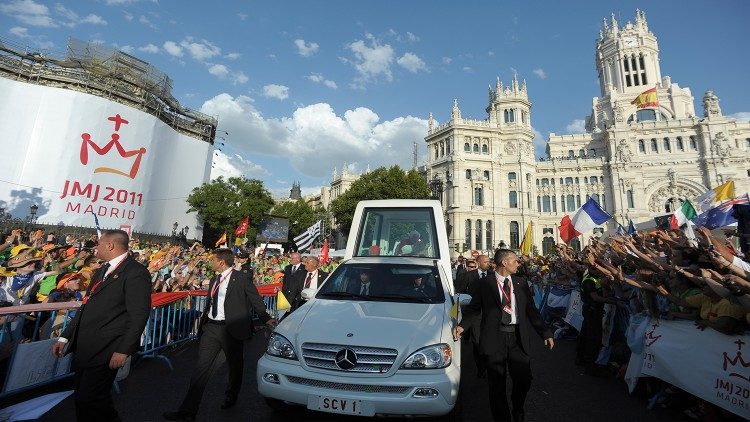
Pope Benedict XVI welcomed millions of young people from around the globe to Madrid in 2011
Prof. de la Cierva, who also worked on the organization of the WYD in 2011, argues this resurgence stems from young people’s search for peace and happiness. The Church’s challenge is to be a welcoming community to them.
“But this is just the start. The challenge for the Church is to help them not just get into the entrance hall of our home [the Church], but to come in and stay and get to know the whole Church,” he explains.
Pope Leo’s visit can be that open door that brings young people back into the Church. Not only that, it can be the catalyst for the revitalization in the Church as a whole in Spain.
Source link



