Foreign News
Pakistan: Balochistan Simmers But No Move To Resolve Issues

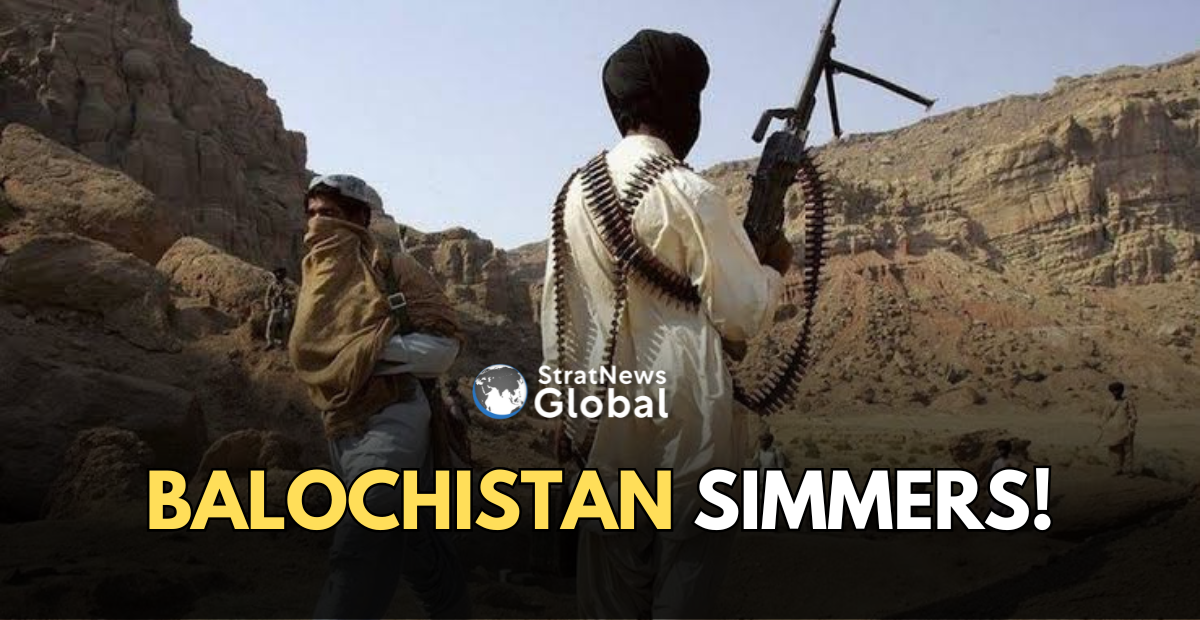
It’s been three days since reports of 45 soldiers being killed in Balochistan, Pakistan’s biggest and strategically crucial province because of its geography, mineral wealth, trade corridors and maritime access. The province serves as Pakistan’s gateway to the Arabian Sea. It hosts the country’s key deep-sea port ambitions, lies along major energy and mineral corridors, and forms the backbone of Pakistan’s western maritime posture.
But for all that, there has been no discernible effort to engage with political groups or social movements to address long-pending grievances.
Priyanka Singh, a researcher at MP-IDSA who focuses on Pakistan and PoJK, said, “There is political will to end the crisis, but none to redress the concerns or demands. That is evident in the kind of high-handedness of the state in dealing with the problem. They have never shown willingness to engage the fighting groups; instead, they have been met with brutal crackdown.”
“Pakistan has always been apathetic to the Balochistan problem, and this has aggravated the situation to an extent that the region has slipped into complete anarchy, and the rebel groups claim to control vast swathes of territory.”
Singh cautions, “Looking at the brutal crackdowns pursued by the pak military, it is apparent they haven’t still learnt that doing so has only aggravated the situation instead. These movements have become so big in magnitude and outreach that it is impossible to bring them down by use of sheer force.”
Pakistani journalist, Arifa Noor, writes in an Op-ed in the Dawn, a local newspaper, “A greater tragedy is the inability of those in power to approach the crisis in Balochistan with any empathy and political will to heal. The causes of the ailment have been discussed at length. It is a political problem that needs a political solution, along with counter-insurgency operations.”
In another op-ed, Maleeha Lodhi, a former Pakistani ambassador to the US and UK, wrote, “The cumulative effect of the failure to address its troubles has left the province completely alienated from the centre. Balochistan’s problem is fundamentally political.”
She notes, “Instead of pursuing political solutions, the state’s managers have relied mostly on military operations and use of force to deal with the unrest. This has only deepened public disaffection and driven more people into the arms of extremist forces.”
“What remains constant is not the source of hope, but the elite’s persistent unwillingness to reconcile it with Pakistan’s actual sociological, political and economic indicators, which tell a far less reassuring story,” warned Muhammad Amir Rana, a Pakistani security analyst.
The Balochistan and Khyber Pakhtunkhwa regions of Pakistan remain highly volatile. Militant attacks have steadily risen in these areas. The growing gap between the state and the civilians has complicated Balochistan’s security landscape. The Pak army’s response strategy remains clear: If it can contain it, it is their win. If they cannot, it is blamed on India.
The nature of the attacks and selection of targets by militants is intended to increase the economic costs of operating in Balochistan. Such actions reinforce insurgent narratives portraying economic activity as the exploitation of Baloch resources, while discouraging external investment.

