

Entertainment
Caritas Venezuela president says priority is the injured and search for survivors


Faced with the devastation caused by two earthquakes, Archbishop José Luis Azuaje Ayala is calling for an unrelenting search for the thousands of people still missing, urging civil society, private companies, and government agencies to “work together so that everyone can help address this difficult situation.”
By Alina Tufani Díaz
“We ask everyone to pray for this country, for all those who are suffering, and also for those engaged in the rescue efforts.”
Speaking to Vatican News, Archbishop José Luis Azuaje Ayala, President of Caritas Venezuela, urged the international community not to lose sight of the consequences of last Wednesday’s devastating earthquakes. He stressed above all the need to intensify the search for those who may still be trapped beneath the rubble.
The Archbishop also called for an immediate assessment of buildings and infrastructure that remain at risk of collapse due to the numerous and powerful aftershocks. He appealed for “a coordinated effort between government agencies and civil society to help minimize the consequences of this tragedy.
Nearly three days after the twin earthquakes, measuring 7.2 and 7.5 on the Richter scale, struck central and northeastern Venezuela, official figures report at least 920 deaths, more than 3,000 people injured, and over 50,000 still missing. According to several non-governmental organizations specializing in emergency response, those numbers could rise significantly.

Rescue teams and volunteers search through the rubble of a building in Caracas. (AFP or licensors) (AFP or licensors)
The Venezuelan government has declared a national state of emergency in the Capital District and the states of La Guaira, Falcón, Carabobo, Yaracuy, Aragua, Miranda, Trujillo, and Lara. The most severe devastation, however, has been reported in La Guaira, just a few kilometers from the capital and home to the country’s main port and international airport.
Fears for the missing
Archbishop Azuaje, Metropolitan Archbishop of Maracaibo—a region not directly affected by the earthquakes—said authorities are still assessing the full extent of the human and material damage, particularly to homes in the hardest-hit areas, parts of Caracas, and especially along Venezuela’s central coast, where both the destruction and seismic activity have been most severe.
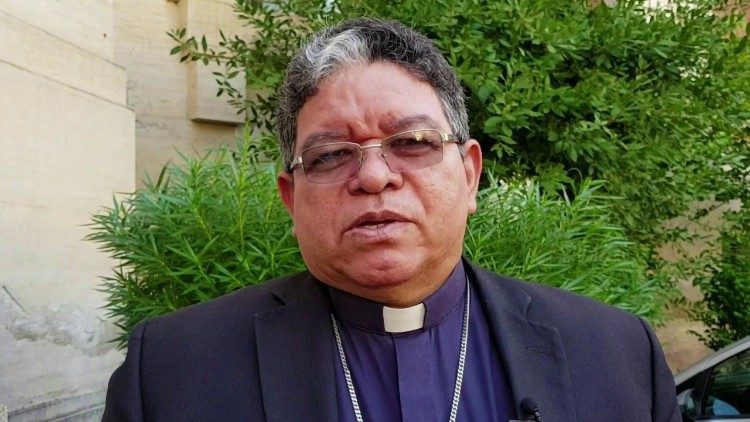
Archbishop José Luis Azuaje Ayala, President of Caritas Venezuela, is also the Metropolitan Archbishop of Maracaibo
“Many people remain missing, and it is believed they are still buried beneath the rubble of several buildings,” the Archbishop said. He noted that not only residential buildings collapsed, but also hotels, recreational facilities, and commercial premises.
“The authorities continue to assess the situation, particularly the search for people who remain buried and trapped,” he added.
Thousands displaced
Archbishop Azuaje confirmed that “thousands of people are sheltering in public squares and open spaces, fearing aftershocks that could bring down additional buildings and infrastructure already severely damaged.”

He also expressed concern over the critical condition of the electricity grid and drinking water distribution systems, which were already under strain and have now completely collapsed in some areas.
Meanwhile, dioceses across the country are organizing collection centers through the Caritas network and other organizations. Efforts are also underway to identify shelters for those who have lost their homes because, the President of Caritas Venezuela noted, “this situation will continue for a long time.”

Aftermath of earthquakes in La Guaira (MAXWELL BRICENO)
It is estimated that more than 70,000 families have been left homeless in La Guaira state alone.
Hospitals under severe strain
The Archbishop also highlighted the serious condition of several damaged hospitals. “Doctors and healthcare workers are doing everything they can, especially to care for the injured and the many people arriving in a state of emotional collapse and suffering from the many consequences of these two simultaneous earthquakes.”
He outlined the immediate priorities: caring for the injured, continuing the search for possible survivors, assessing infrastructure vulnerable to aftershocks, and coordinating efforts between government agencies and civil society “to work together to minimize the consequences of this tragedy.”
Caritas Venezuela, he added, “has been on the ground since the early hours of the morning, especially in the hardest-hit areas, with the primary goal of assisting in the rescue of victims trapped beneath the rubble, while also searching for missing persons at locations identified by relatives and friends.”
The psychological toll of the disaster
The psychological impact of the disaster—including widespread anxiety and uncertainty caused by the continuing aftershocks of varying intensity expected over the coming days—has become another major priority for Caritas Venezuela.

Emergency treatment centers are caring for the injured as hospitals become overwhelmed. (AFP or licensors) (AFP or licensors)
“As Caritas and as the Catholic Church,” Archbishop Azuaje said, “we are trying to help everyone as much as possible so that they can find hope and, above all, overcome the psychological and emotional crisis that unfortunately brings uncertainty and many other negative consequences into people’s lives.”
A call for help
The President of Caritas Venezuela appealed to the entire national and international community to contribute through financial donations as well as non-perishable food, medical supplies, first-aid equipment, and any other resources that can help respond to the disaster.

Many families who have been unable to secure emergency shelter are living outdoors. (MAXWELL BRICEÑO) (MAXWELL BRICENO)
“This is what we are working on,” he said, “and above all we are encouraging civil society, private companies, and government agencies to join forces so that everyone can contribute to addressing the difficult situation our country is facing.”
A prayer for Venezuela
Archbishop Azuaje concluded by expressing gratitude for the Christian compassion and charity shown by the many institutions and countries that have stood in solidarity with the Venezuelan people during this difficult time.
“We ask everyone,” he said, “to pray for this country, for all those who are suffering, and also for those who are helping, so that the Lord may grant strength and encouragement—especially to those digging through the rubble—to continue working for the good of so many people.”
Source link



