

Education
Faculty Spotlight: How art history professor Paul Niell’s research informs hurricane preparation


Niell studies Indigenous Caribbean architecture and how it can inform present-day conversations about resilience, sustainability and hurricane-ready design. In a region where storms have long shaped daily life, older building traditions offer lessons in strength, repair and adaptation.
His interest began with what dominant narratives of American architectural history often left out: the Caribbean. As an undergraduate at the College of Charleston, Niell saw how frequently the field centered on Europe and the United States instead.
That omission matters because Caribbean architecture reflects Indigenous knowledge, Spanish colonization, African and African-descendant traditions, European ideas about masonry and permanence and modernism — all shaped by climate, materials and place.
One of the clearest examples is the role of flexibility in traditional structures. Niell points to a key shift that followed European arrival: the move from plant-based cordage to nails.
“One of the things that is really pivotal with the European arrival is a transition to the use of nails from the use of plant-based cordage, where joinery in a building where the pillars and the beams meet are tied with very strong vines,” Niell said.
To European observers, vines may have seemed less durable than nails. But Indigenous knowledge keepers have described woody vines with substantial strength, including vines that could continue to grow and tighten a structure over time.
“When a building comes under a lot of lateral stress from oscillating wind currents, the hurricane-force winds are very violent,” Niell said. “That flexibility is really important for the building hanging together, whereas nails introduce this kind of rigidity.”
The insight challenges the assumption that more rigid always meant stronger. In hurricane-prone places, resilience may depend on movement as much as resistance.
Flexibility is only part of the story. Niell also emphasizes repair and renewal. Thatching could be sourced locally and replaced when needed, meaning these systems incorporated maintenance into their design.
“We see in Indigenous Caribbean architecture, we see a lot of cycles of repair, that there is a sort of understanding of renewal that’s built into the architecture, versus a European idea that you build a building and it’s finished,” Niell said.
That idea broadens hurricane readiness beyond preventing damage. A resilient building culture also plans for recovery, uses available materials and understands that structures exist within environmental cycles.
For modern Florida, Puerto Rico and other storm-prone places, Niell sees practical relevance. Buildings that rely heavily on concrete and air conditioning can strain energy systems, especially where power grids are vulnerable. Older Caribbean buildings often used courtyards, galleries, high ceilings and tall windows to promote natural ventilation.
Those lessons do not translate simply into a blueprint for contemporary housing, but the principle remains powerful: Architecture in hurricane-prone regions should begin with ecological reality, not fight against it.

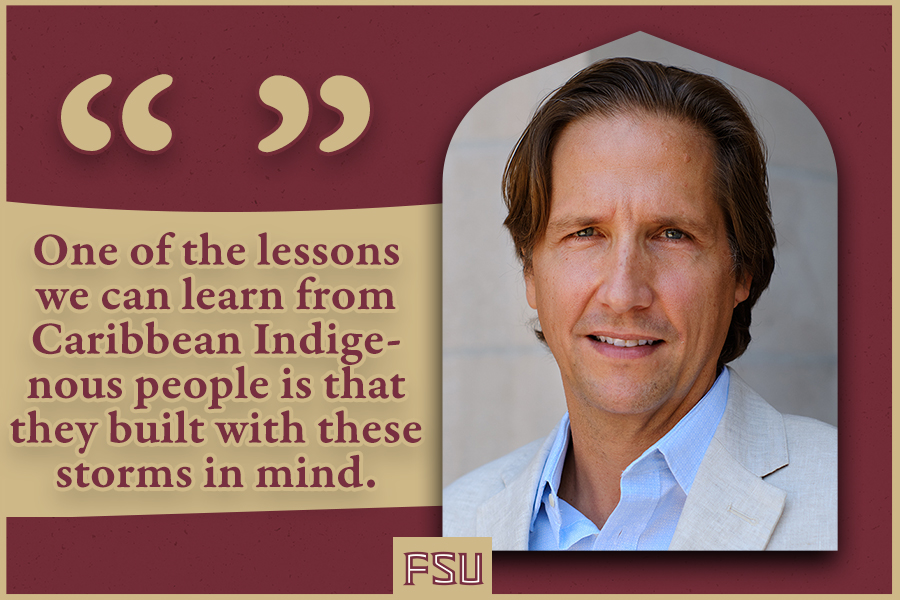
“One of the lessons, I suppose, we can learn from Caribbean Indigenous people is that they built with these storms in mind,” Niell said.
Niell’s work also points to Indigenous knowledge as living knowledge. Through projects including Forgotten Canopy, he has collaborated with academics, archaeologists, architectural historians and Indigenous experts, including Everett Osceola, a cultural ambassador of the Seminole Tribe of Florida, who shared perspectives on the Seminole chickee.
For Niell, these collaborations show that hurricane-ready architecture may require more than new technologies or stronger materials. It may also require renewed attention to older ecological knowledge from communities that have long lived with environmental flux.
As storms test homes, infrastructure and communities across Florida and the Caribbean, Niell’s research asks readers to reconsider what it means to build well: less about conquering nature than learning how to live within it.



