

Entertainment
UNHCR: Pope Leo’s Lampedusa visit a call for shared responsibility


Ahead of Pope Leo XIV’s visit to Lampedusa, UNHCR Communication Officer Filippo Ungaro says the Pope’s presence offers a powerful reminder that migration must be approached with solidarity, shared responsibility, and an unwavering commitment to the dignity and protection of every human person.
By Alessandro Guarasci and Linda Bordoni
As Pope Leo XIV prepares to visit the Mediterranean island of Lampedusa on Saturday, a place long synonymous with both tragedy and hope, the UN refugee agency says his presence carries a powerful message for a world increasingly focused on borders rather than people.
Lampedusa, Italy’s southernmost island, has for decades stood at the crossroads of migration routes from North Africa to Europe. For countless refugees and migrants fleeing war, persecution, poverty and instability, it has been the first place of safety after perilous sea crossings. Yet it is also a place marked by profound loss, where thousands have perished in the waters that surround it.
A place of grief and a place of hope
For Filippo Ungaro, Communication Officer for UNHCR, Pope Leo’s visit comes at a crucial moment in the global conversation on migration.
“UNHCR, the UN refugee agency, welcomes Pope Leo’s visit to Lampedusa on the 4th of July,” he told Vatican News, adding that “Lampedusa remains one of the most powerful symbols of the central Mediterranean routes. It is a place of arrival, a place of grief, and a place of hope.”
Ungaro noted that thousands of refugees and migrants have found safety on the island after enduring “horrendous journeys across the sea,” while many others—women, children and men—have lost their lives attempting to reach its shores.
In that context, he said, the Pope’s presence speaks with particular force.
“Pope Leo’s presence sends a clear message at a time when the global political debate on migration is often framed around the protection of borders and deterrence, rather than the protection of people and the shared responsibility for managing migration,” he said.
The visit inevitably recalls the prophetic gesture made by Pope Francis in July 2013, when Lampedusa became the destination of his first pastoral journey outside Rome. On that occasion, he denounced what he termed the “globalisation of indifference” in the face of the suffering of migrants and refugees.
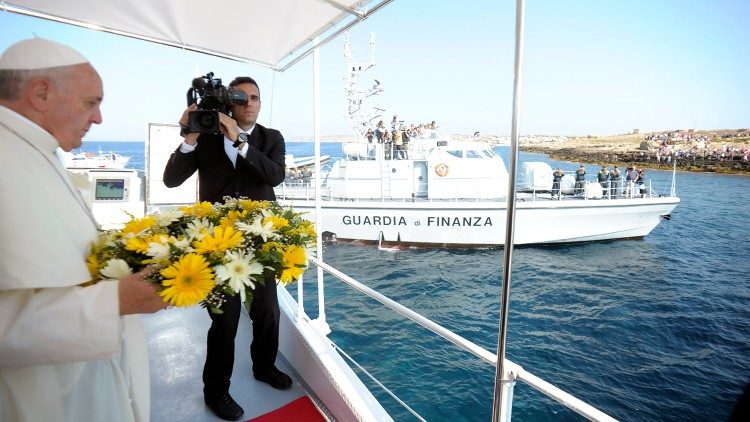
Pope Francis’ visit to Lampedusa on 8 July 2013
Need for renewed political commitment
More than a decade later, Ungaro believes the challenges remain urgent and require renewed political commitment.
Asked what changes are needed to ensure that the dignity of migrants and refugees is fully respected, he pointed to the need to balance effective migration management with genuine protection for those fleeing danger.

“The European Union must be able to combine the effective management of migration flows with the real protection of those fleeing war, persecution and human rights violations,” he said.
EU Pact on Migration and Asylum
Ungaro referred to the recently adopted EU Pact on Migration and Asylum, noting that it offers opportunities for greater coordination among Member States.
“The EU Pact has the potential to bring greater modernisation among Member States in the management of arrivals and in the application for international protection,” he explained. “But the main challenge remains its concrete and operational implementation.”
He stressed that beyond legislative frameworks, the question ultimately requires political will and a stronger commitment to international solidarity.
“A further point is the need to provide stronger support to the countries that host the majority of the world’s refugees,” Ungaro said, noting that around seventy percent of refugees are sheltered by low- and middle-income nations.
In that sense, he concluded, “we need greater responsibility-sharing in the management of migration flows.”
Source link



