

Education
FSU launches Presidential Lectureship in Chemical Sciences


Key Points
- Florida State University launched the Presidential Lectureship in Chemical Sciences to recognize influential leaders in chemistry and connect FSU faculty and students with leading scientists.
- Internationally recognized chemist Eric Anslyn of the University of Texas at Austin was selected as the inaugural recipient of the Presidential Lectureship in Chemical Sciences for his pioneering research in molecular recognition and chemical sensing.
Florida State University launched its Presidential Lectureship in Chemical Sciences on Wednesday, honoring internationally recognized chemist Eric Anslyn as its inaugural recipient.
The new lectureship recognizes extraordinary achievement and influence in chemistry while giving FSU faculty and students opportunities to engage with leading scientists. The lectureship also elevates the national visibility and reputation of Florida State University’s distinguished Department of Chemistry and Biochemistry.
“I wanted to bring really important people to the university and let them have a chance to get to know our great university and great department,” said President Richard McCullough.
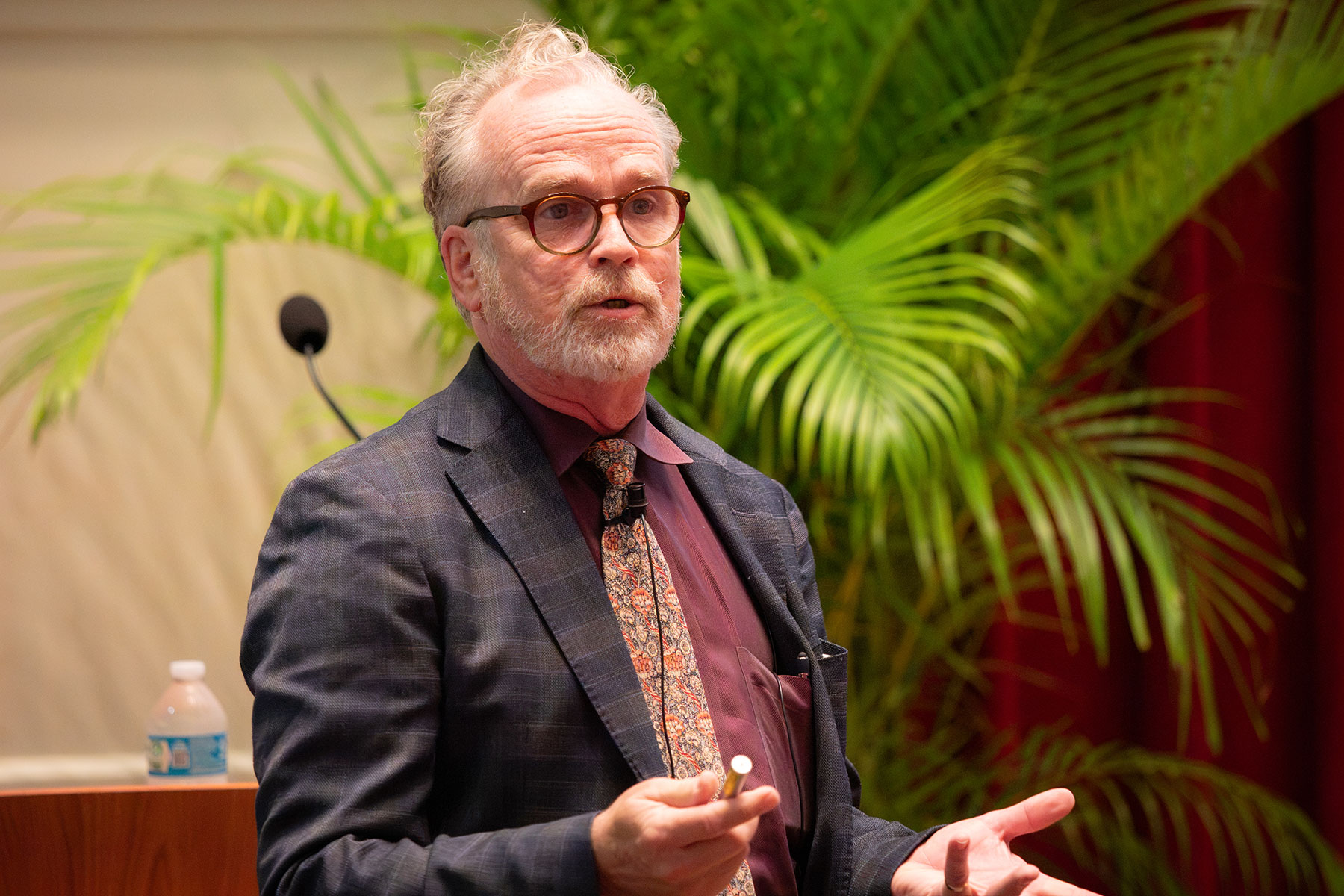
Anslyn is the Welch Regents Chair in Chemistry and a Distinguished Teaching Professor at the University of Texas at Austin. A prominent scholar in supramolecular and physical organic chemistry, his research has advanced molecular recognition and chemical sensing, with applications ranging from biochemical analysis and medical diagnosis to the detection of nerve agents and counterfeit wine.
Introducing Anslyn, McCullough reflected on their longstanding friendship, which began when they were postdoctoral researchers at Columbia University, while highlighting Anslyn’s pioneering contributions and lasting impact on the chemical sciences.
“I just never met anyone that could do theoretical chemistry and experimental chemistry,” McCullough said. “I was just really, really impressed by him.
McCullough presented Anslyn with the first Presidential Lectureship in Chemical Sciences Award. This honor includes a commemorative award and support for the recipient’s continued research.
In his lecture, “The Senses of Taste and Smell: Differential Sensing Concepts and Applications,” Anslyn discussed how sophisticated chemistry can solve practical, everyday problems. Some examples were using LEGOs and smartphones to detect nerve agents and developing sensor arrays capable of identifying counterfeit pinot noir.
An entertaining speaker with a passion for his field, Anslyn concluded his talk by telling the audience why he loves chemistry.
“We get to innovate and synthesize and design and build new things and test the properties,” Anslyn said. “When I was a kid, I played with Lincoln Logs, I built airplane models, I raced go karts, so I was rebuilding motors. I was always building and constructing something. And, in chemistry, we’re always building and constructing something. That’s why I love this job so much.”



