

Education
Collaborative research by FSU physicists uncovers novel electronic properties in quantum material



Florida State University physicists are part of a team that has discovered unusual superconducting states in parts of graphene, with the potential to drive unexpected quantum technologies.
Assistant Professor of Physics Cyprian Lewandowski and postdoctoral researcher Phong Võ Tiến are part of an international collaboration that has uncovered new aspects of superconductivity and topology in rhombohedral graphene, a system comprising just a few layers of carbon atoms stacked like the treads of a staircase shape known as chiral stacking. The work was published in Nature Physics.
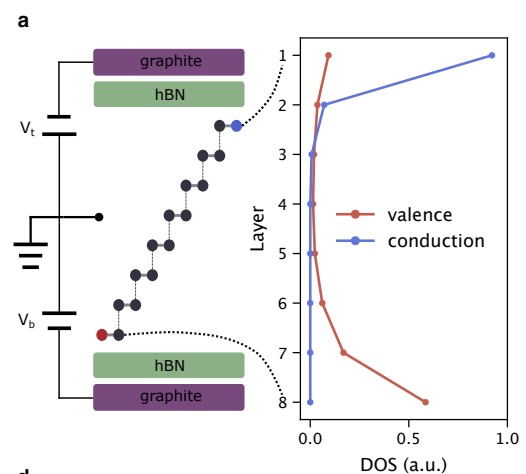
“The rhombohedral graphene system seems to capture many of the intriguing electronic phenomena that scientists have seen previously in other atomically thin systems, but they were previously not as ideal for technical applications due to the intrinsic complexity of the devices or replicability issues,” Lewandowski said. “In physics, once we identify a generic phenomenon, we try to distill it to its essential form to understand the underlying mechanism. This rhombohedral system allows us to do that. We’ve identified the natural occurrence of this effect and can build upon and optimize it to achieve properties only before seen in more complicated systems.”
Atomically thin flakes of rhombohedral graphene can be isolated from naturally occurring graphite crystals. In this structure, at a low energy, electrons are localized almost exclusively onto specific atoms on the top and bottom surfaces. By contrast, very little charge resides in the bulk of the material.
Congregating a large density of electrons onto the outer surfaces leads to interesting emergent quantum properties, as charges are forced to collectively “make choices” about how they reside on the surfaces while simultaneously repelling each other. The team found that superconductivity emerges directly from this dual-surface configuration, where electron and hole carriers on opposite surfaces conspire to form a superconducting state.
Collaborating on impactful science
FSU was joined in the collaboration by experimentalist teams led by co-principal investigators Matthew Yankowitz, associate professor of physics at the University of Washington in Seattle, and Joshua Folk, professor of physics at the University of British Columbia in Vancouver, Canada. Together, the team combined material and structure assembly expertise required to build highly sensitive and optimized electronic devices, measurement expertise to probe ultra-sensitive superconducting states that emerged from them, and theoretical expertise to turn experimental data into a coherent understanding of superconductivity in this novel platform.
“An added complexity of this system is that negative and positive charges coexist,” Yankowitz said. “On one surface, the charges are electrons and therefore negatively charged. On the other surface, they behave like particles called holes, which are effectively positive. This work is advancing our fundamental understanding of the interplay of strongly correlated and topological phases, which could be an avenue toward the development of future quantum technologies.”
In addition to superconductivity, the team observed a quantum anomalous Hall effect — a topological state in which an electrical current flows without resistance along the edges of the material.
“Cyprian is applying his brilliant theoretical insights to cutting-edge problems in the science of quantum materials,” said Mike Shatruk, director of the FSU Initiative in Quantum Science and Engineering. “If the two phenomena of superconducting behavior and topological states can eventually be made to co-exist, theory predicts appearance of so-called Majorana zero modes, which are candidate building blocks for fault-tolerant quantum computing; they’re inherently protected from local noise and decoherence that destroy quantum information.”
Next-generation quantum devices
One of the team’s guiding goals is to eventually translate the research into the realm of quantum engineering for the development of next-generation devices and detectors. Another significant aspect of the system is that there are two electronic layers of charges separated vertically, a geometry that previously had to be manually constructed. Discovering such material states that occur naturally can lead to exciting new avenues in fundamental physics and potential technological applications.
“In the 20th century, scientists gained a lot of our modern understanding of condensed-matter physics and phase transitions by working with helium, and I would argue that rhombohedral graphene may be serving the same purpose here in teaching us about unique crystalline phases of matter,” said Lewandowski, who utilizes the FSU Research Computing Center and the National Science Foundation-funded, FSU-headquartered National High Magnetic Field Laboratory in his work.
This research was supported by funding from the U.S. Army Research Office, the U.S. Department of Energy, NSF and FSU. Other contributors include scientists from the National Institute for Materials Science in Tsukuba, Ibaraki, Japan.
Visit the FSU Department of Physics website to learn more about Lewandowski’s work and research. For more details on quantum science and engineering at FSU, visit the FSU Quantum Initiative website.




