

Entertainment
IOM: Pope Leo’s Lampedusa visit will highlight human dimension of migration


The International Organization for Migration (IOM)’s Chief of Mission for Italy and Malta says Pope Leo XIV’s visit to Lampedusa offers a powerful reminder of the human dignity of migrants and the need for shared responsibility.
By Linda Bordoni
As Pope Leo XIV prepares to visit Lampedusa on 4 July, the southern Italian island’s migrant reception centre is struggling to cope with a surge in arrivals. For decades, Lampedusa—closer to North Africa than mainland Italy—has been a gateway to Europe for migrants and refugees risking the Mediterranean crossing, with more than 182,000 arrivals recorded over the past three years.
The Pope’s visit follows in the footsteps of Pope Francis’ historic journey to the island on 8 July 2013, when he condemned the “globalisation of indifference” towards those forced to flee. More than a decade later, migration remains a defining global challenge, with over 26,000 people having died in the Central Mediterranean since 2014, according to the International Organization for Migration’s “Missing Migrants Project”.
Speaking to Vatican Radio, Salvatore Sortino, Director of the IOM Coordination Office for the Mediterranean, Chief of Mission for Italy and Malta, and IOM representative to the Holy See, welcomed the visit, reiterating that Pope Leo’s voice is an important moral force in an increasingly polarised debate on migration.
“I think that the work that the Pope, His Holiness, and the Holy See are doing in terms of highlighting the importance of migration and the dignity of migrants – all people on the move, those requesting protection and those seeking better economic opportunities – is extremely important and timely nowadays,” he says.
Sortino describes the Pope as “a great support” and “a great amplifier” of efforts to place human dignity at the centre of migration governance.
“Migration, if properly managed, is really a solution for some of the biggest challenges related to global inequality, protection, and even climate change impacts,” he explains. “We incredibly appreciate the commitment of the Holy See and, of course, of Pope Leo through this visit, which really sends a message.”
That message, he says, comes at a critical moment.
While recent years have seen reductions in arrivals along some migration routes, the journeys themselves have become increasingly dangerous. Sortino points in particular to sea crossings, where vulnerability has intensified despite lower overall numbers.

Rescued migrants arrive in Lampedusa
“We have seen how, despite reductions in numbers, the number of migrants who unfortunately die at sea or become victims of accidents has increased,” he notes, explaining that vulnerability has intensified despite lower overall numbers.

Thus, he continues, the Pope’s presence serves as a reminder that migration cannot be reduced to statistics.
“I think the Pope sends an important message to lawmakers, communities, law enforcement authorities, and the general public about the importance of receiving migrants with full awareness of their dignity as human beings.”
Remembering Francis, confronting today’s realities
The memory of Pope Francis’ visit remains deeply woven into Lampedusa’s identity. Yet, according to Sortino, many of the fundamental challenges highlighted in 2013 remain unresolved.
“Several things have changed,” he reflects, “and I wish I could say they have all changed for the better. Unfortunately, that is not the case.”
Although arrivals have decreased in recent years, he cautions against interpreting this as evidence that fewer people are in need of protection or opportunities.
“That doesn’t mean fewer people are in need of taking that journey,” he says. “The data provide evidence that, compared with the reduced number of arrivals, the number of incidents and migrants who have died at sea has increased proportionally.”
For IOM, this reality underscores the need to strengthen search-and-rescue systems and improve migration management along entire migration routes.
“The whole-route approach has to be strengthened and improved,” he says.
At the same time, Sortino welcomes ongoing efforts within Europe to create more coherent migration frameworks, while stressing that implementation must remain firmly anchored in human rights and international law.
“The importance for us is maintaining guarantees to access asylum for those who need it and, of course, full respect for international law and human rights.”

IOM staff in Lampedusa (@IOM)
Beyond emergency responses
For humanitarian actors, however, rescue operations alone are not enough. “The importance of search-and-rescue operations remains a central element of protection in the Mediterranean,” Sortino insists. “But opening legal pathways is eventually the real answer.”
Addressing root causes such as conflict, poverty, and climate-related pressures remains essential, he says, but so too does creating viable alternatives to dangerous journeys.
“There is a tremendous effort to do so,” he explains. “We need effective legal pathways into Europe and into Italy.”
That means simplifying procedures, engaging employers, and creating systems that match labour needs with the skills migrants can offer. “The ability to create matching systems that work – where employers and those who offer their skills can really connect – is crucial.”
The indispensable role of faith communities
Among the actors helping migrants navigate often complex journeys, faith-based organisations occupy a unique place, and for Sortino, their contribution extends far beyond emergency assistance.
“We talk about migration sometimes in a very abstract manner, through categories,” he says. “But in the end, we are talking about people who end up in communities.”
Faith communities, he argues, are often closest to those realities.
“Very often those most directly engaged in first support, reception, integration support, and social inclusion activities are faith-based organisations or the Church,” he says, noting that this is particularly significant in Italy, where local communities, parishes, charities, and volunteer networks play a key role in accompanying newcomers and fostering inclusion.
“They populate and animate the territory,” he says, helping ensure that support reaches places where it is most needed.
Moving beyond toxic narratives
Sortino also expresses concern over the tone of public debate surrounding migration. “It is unfortunate to see what is often an idiotic use of toxic narratives around migrants,” he says, noting that “They do not help.”
He believes instead that evidence-based discussion is urgently needed, especially since public perceptions frequently focus almost exclusively on irregular arrivals by sea.
“When we talk about migration in Italy, we think about the boats arriving in Lampedusa,” he notes. “In fact, that is a very small part of the entire migration phenomenon.”
Most migration to Italy and Europe, he points out, takes place through regular channels linked to work, study, and family reunification, and he highlights the significant contribution migrants make to Italian society.
“There are almost 5.5 million regular migrants in Italy,” he says. “They account for about 9 per cent of GDP. That is really significant, but it is not talked about enough.”
For this reason, he sees Pope Leo’s visit as an opportunity to shift attention away from fear and toward facts.
“We need the support of every organisation, small and large, in giving light and voice to narratives grounded in evidence and facts.”

IOM staff at the Port in Lampedusa (@IOM)
A spotlight on the human face of migration
Sortino himself plans to be in Lampedusa during the papal visit and speaks with evident enthusiasm about what it could mean for the island and for migrants arriving there.
“I am really very excited that there is going to be such an incredible spotlight,” he says as he describes Lampedusa as a “virtuous” example of cooperation among authorities, humanitarian organisations, NGOs, and international agencies, adding that he has always been “impressed by how solid the collaboration is.”
Above all, he hopes Pope Leo’s presence will draw attention to the stories behind the headlines.
“The presence of the Pope in that space will add even more attention, I think and hope, to the human aspect,” he says.
“The hopes of the migrants who arrive, the sufferings they endure, and the importance that we all pay attention to that angle rather than the numbers themselves.”
As Lampedusa prepares to welcome Pope Leo XIV, the island once again becomes a symbol — not only of migration routes and border policies, but of the lives, hopes and dignity of the people who cross its shores.
For humanitarian workers such as Sortino, that may be the most important message the Pope can bring: a reminder that behind every statistic is a human person, deserving of protection, opportunity and respect.
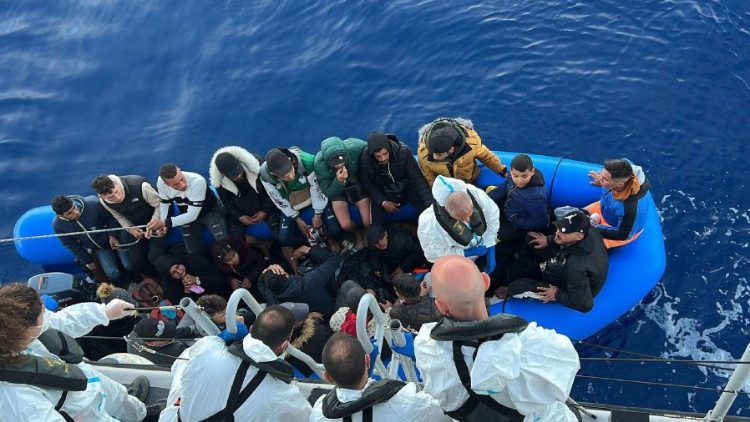
File photo of a Lampedusa-based rescue operation (ANSA)
IOM in Lampedusa
On Lampedusa itself, the IOM works alongside Italian authorities and humanitarian partners at every stage of reception and assistance.
Sortino explains that the organisation provides cultural mediators to support Coast Guard search-and-rescue operations, where effective communication can be a matter of life and death, and assists public security teams during registration and screening procedures.
IOM staff also help identify victims of trafficking and other vulnerable people, ensuring they are referred to the appropriate authorities and supported in transfers to suitable facilities on the mainland, always in close collaboration with other institutions, international organisations and civil society.

Salvatore Sortino during the interview with Vatican News
Source link



