

Education
Faculty Spotlight: How a Florida State University professor is advancing music therapy in healthcare


Key Points
- Known as an emerging healthcare practice, music therapy is shown to have numerous health benefits and is practiced at Florida State University’s College of Music.
- FSU Professor of Music Therapy Lori Gooding is shaping Florida State University as an industry leader in a growing field.
Although music has been used as a form of healing for centuries, music therapy is still considered an emerging healthcare practice. At the Florida State University College of Music, a professor is helping to grow this clinical intervention that addresses everything from anxiety to physical rehabilitation.
Professor of Music Therapy Lori Gooding is accelerating the industry through research and translational courses. She believes there is a misconception surrounding music therapy that needs to be cleared up.
“A lot of people don’t recognize that music therapy is a profession you train for, that you have academic and clinical training, that there’s a board certification exam you have to pass and there’s licensure in many states,” Gooding said.
She also addressed the core difference between the informal therapeutic benefits of listening to a favorite playlist and clinical, evidence-based music therapy, as they are often thought of as one.
“The difference between that and what we do in music therapy is that we are going in and assessing an individualized need, and we are using music within the context of a therapeutic relationship to help someone restore, maintain or improve their functioning,” Gooding said.
FSU is nationally recognized for having one of the earliest established leading programs in music therapy with a 100% placement rate among graduates. The program often places its graduates in fields such as medicine, mental health, special education, hospice and older adult services.
Gooding attributes the program’s success to equipping students with the latest research so they enter the workforce fully prepared.
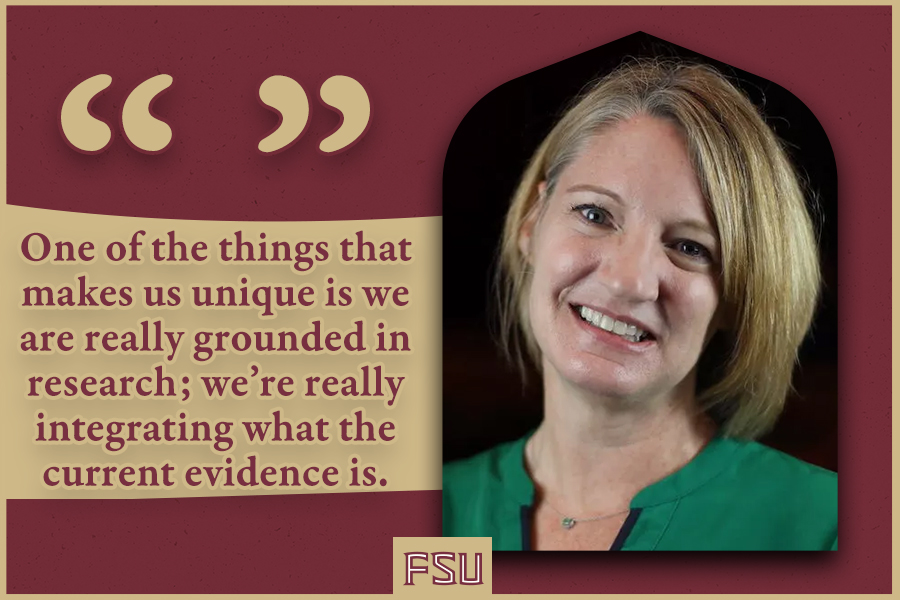
“I think one of the things that makes us unique is we are really grounded in research; we’re really integrating what the current evidence is,” Gooding noted. “They’re also learning how to generate new evidence. It’s going to not just keep practice current but actually push practice forward. It’s that combination, I think, that sets us apart.”
In addition, in partnership with Tallahassee Memorial HealthCare, FSU offers a NICU-MT certificate program through the College of Music. Gooding explains how this program highlights the physical relief music therapy can offer its patients.
“We’re watching the monitors for their heart rate, their respiration rate, the oxygen saturation rate, and so on,” Gooding said. “And based on what’s happening, knowing where those levels need to be, and watching what’s happening while we’re doing the music intervention, we actually adjust what we’re doing.”
Gooding’s practice aligns with FSU Health, the university’s integrated health system that brings together hospitals, physicians, clinics, research, education and innovation to improve the health of the communities FSU serves. According to the National Alliance on Mental Illness, music therapy’s countless benefits include lowering blood pressure, improving memory, enhancing social skills, reducing muscle tension and more.
Music therapy can also be particularly effective for mental health treatments. Gooding noted that for anxious patients, integrating music into preexisting methods of relaxation can minimize their stress levels.
“A lot of people do relaxation exercises like deep breathing, that kind of thing,” Gooding said. “We take those similar concepts and pair it with music, so that if someone is feeling anxious, or if they’re noticing that their heart rate is elevating, they can use the steady pulse of a piece of music or a music exercise or experience to help their body kind of get in line with that steady pulse, which is going to help literally physiologically slow them down.”
Music therapy can be particularly effective in treating adolescents struggling with their mental health. In these cases, there are a variety of methods specialists may use, including analyzing lyrics.

“Where it might be a challenge for someone to engage in just one-on-one talking directly about themselves, we can find a song that has lyrics that are relevant to what that person is going through, and that creates a space that allows people to say, ‘Well, I noticed this in the song, you know what? I do that sometimes too,’” Gooding said.
The evidence-based practice remains a versatile profession, offering a range of clinical approaches designed to meet patient needs. An essential component of the field lies in its individualized nature, ensuring that every treatment is tailored to support each patient’s specific needs.
“One person could love heavy metal music and find that relaxing because it’s their favorite kind of music, whereas for another person, that’s going to increase their anxiety,” Gooding said. “We really lean into that patient-preferred piece to try to connect with them.”
As she trains the next generation of music therapists, Gooding is bolstering an emerging healthcare practice ready to put its patients at ease. One of music therapy’s early pioneers, the FSU College of Music is proving once again that great music has strong healing power.



